


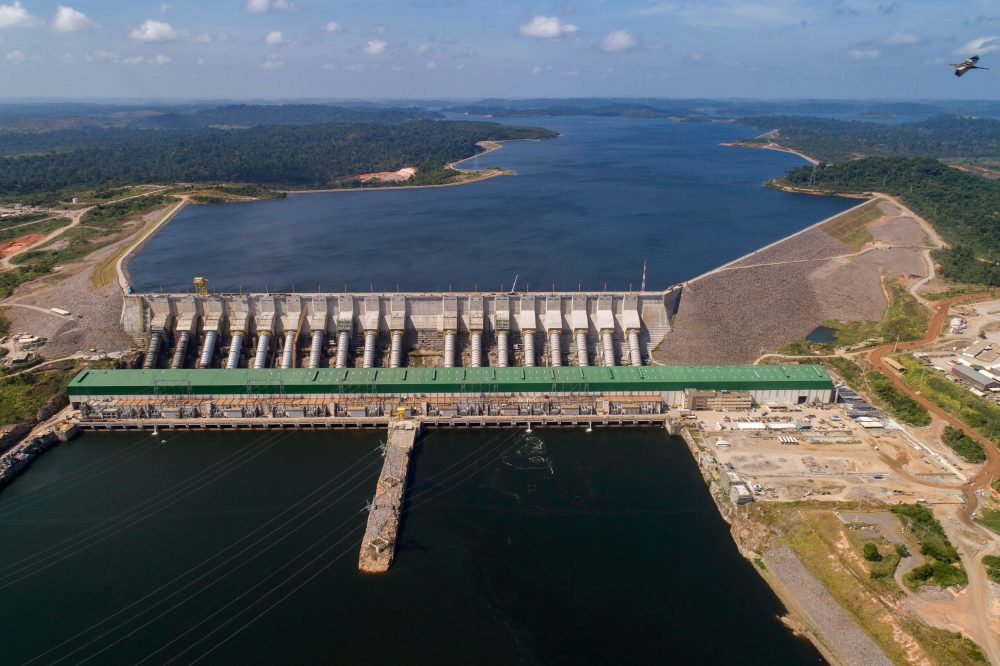
SAO PAULO (AP) — The Belo Monte hydropower plant in the Brazilian Amazon, one of the world’s largest, was designed to channel water from the Xingu River in a way that would avoid the need for large reservoirs, which could flood surrounding areas.
After years of legal battles, authorities approved the project, located in the southwestern part of the state of Para, on one condition: it would not threaten ecosystems and communities of Indigenous people along stretches of the river.
A decade after operations began in 2016, Brazilian courts have found that Belo Monte failed to meet that requirement and that its environmental and social impacts were far greater than forecast.
“They were just confirming what we already knew,” said Ana Laíde Barbosa, a member of Movimento Xingu Vivo, an advocacy group that has been fighting the Belo Monte project since 2008.
The courts’ understanding, she said, did not happen by chance: “There was research, experience. There was ancestry and inherited knowledge.”
The legal setbacks raise broader questions about Brazil’s reliance on hydropower, with several dams supplying most of the nation’s electricity. Belo Monte, the second largest, was originally planned during the military dictatorship in the 1970s but wasn’t pushed forward until decades later by President Luiz Inácio Lula da Silva in 2010, during his second term. Today, it supplies about 10% of Brazil’s electricity.
In December, the Supreme Court ordered the federal government to pay 19 million reais ($3.6 million) in compensation to Indigenous communities affected by the dam.
Separately, a local court ordered Norte Energia, the company that built and operates Belo Monte, to supply clean water to communities whose natural sources dried up, leaving them dependent on bottled water.
In the most consequential ruling, a federal judge ordered Norte Energia to reassess how much water it diverts from the Xingu River to run its turbines, a move the company says could reduce power output.
Norte Energia said the ruling ordering a review of water management would have no immediate effect, noting that any changes could occur only after all appeals are exhausted. It also said its current model balances environmental concerns with energy security and consumer costs. The company has begun supplying water to families in the Xingu region, delivering 20‑liter jugs every 15 days, according to local leaders, though not all households have been registered.
Belo Monte was built amid protests and a licensing process that faced many legal challenges. In 2012, construction was temporarily halted after a court ruled that potentially impacted communities had not been properly consulted. Norte Energia denied the damages and said the dam did not displace or flood Indigenous communities.
Starting in February, new legislation passed by Congress last year will fast-track approval of strategic infrastructure projects. Analysts say impacts from large projects like Belo Monte could become more common.
Licensing processes that until now took six or seven years and required three separate permits will now be completed within 12 months. “That clearly means less rigorous scrutiny of social and environmental impacts,” said Suely Araújo, a policy coordinator at the Climate Observatory, a network of environmental nonprofits.
Natalie Unterstell, president of Talanoa, a Brazilian climate think tank, said Belo Monte illustrates how impacts such as altered river flows — including those intensified by climate change — are often underestimated.
“Belo Monte is a reminder that climate leadership is not just about curbing deforestation or making speeches at COP summits,” said Unterstell, referring to the annual U.N. climate conference, which Brazil hosted last year. “It is also about how the state plans, operates and corrects infrastructure in an era of climate change.”
The Brazilian Institute of Environment and Renewable Natural Resources said in a statement the new legislation will potentially impact environmental protection and legal certainty.
The Juruna, are one of the more than two dozen Indigenous and traditional communities living along a 130-kilometer (80-mile) stretch of the Xingu River affected by the dam. They tie their existence to the river, which they regard as a family member, a connection so deep that they commonly say they “have canoes instead of feet.”
To operate, Belo Monte diverts 70% to 80% of the river’s flow. When the plant began operating in 2016, Juruna leaders say it marked “the end of the world.” Fish died in large numbers, navigation became nearly impossible and access to neighboring communities, schools and health care was severely restricted. Their diet shifted from fish to processed food.
“The impact was huge — environmental, social, cultural. And psychological, too. Some people, like my father, suffered deeply in ways I had never seen before,” said Josiel Jacinto Pereira Juruna, a 33-year-old Indigenous leader.
Indigenous and riverine communities had long warned that diverting water would collapse interconnected river systems.
In 2013, before the river was dammed, the Juruna people began organizing to monitor anticipated impacts.
The Indigenous monitoring group, known as MATI, later partnered with scientists from two Brazilian universities and Brazil’s National Institute for Amazonian Research. They collected evidence that helped prosecutors build a case showing Belo Monte’s impacts were far greater than Norte Energia had acknowledged.
Monitoring is carried out daily by Indigenous and riverine residents, who track water levels, groundwater, fish spawning areas and catches using mobile apps and field notebooks. The data is later digitized and jointly analyzed with researchers.
Josiel Juruna said the ruling brought a sense of validation. “We have to fight so much, prove so much. There is so much evidence, so many things happening, but at the same time nothing changes,” he said.
Recent studies show that because of the Xingu River’s characteristics and intensifying droughts, the plant rarely operates at full capacity. Norte Energia has said that revising water diversion, as ordered by the court, could increase electricity prices and force greater reliance on thermal power plants, leading to higher carbon emissions.
Raimundo da Cruz Silva, a fisherman who turned to a struggling cocoa farming after Belo Monte, lives in the world’s largest rainforest and river basin — yet he struggles with a water crisis.
“Today, the territory is completely lacking potable drinking water,” he said.
Wells that once reached water at two to three meters (6.5 to 10 feet) now must be dug as deep as 15 meters (49 feet), and even then “some still produce nothing.”
Araújo, from Climate Observatory, said shutting down Belo Monte is not under discussion, but that a future renewal of its operating license should depend on measures to reduce impacts to people and the environment.
“Brazil’s history with hydropower must be a learning process,” she said. “We can’t accept that social and environmental impacts are ignored. They must be assessed with the highest level of rigor.”
___
The Associated Press’ climate and environmental coverage receives financial support from multiple private foundations. AP is solely responsible for all content. Find AP’s standards for working with philanthropies, a list of supporters and funded coverage areas at AP.org.
Brought to you by www.srnnews.com