


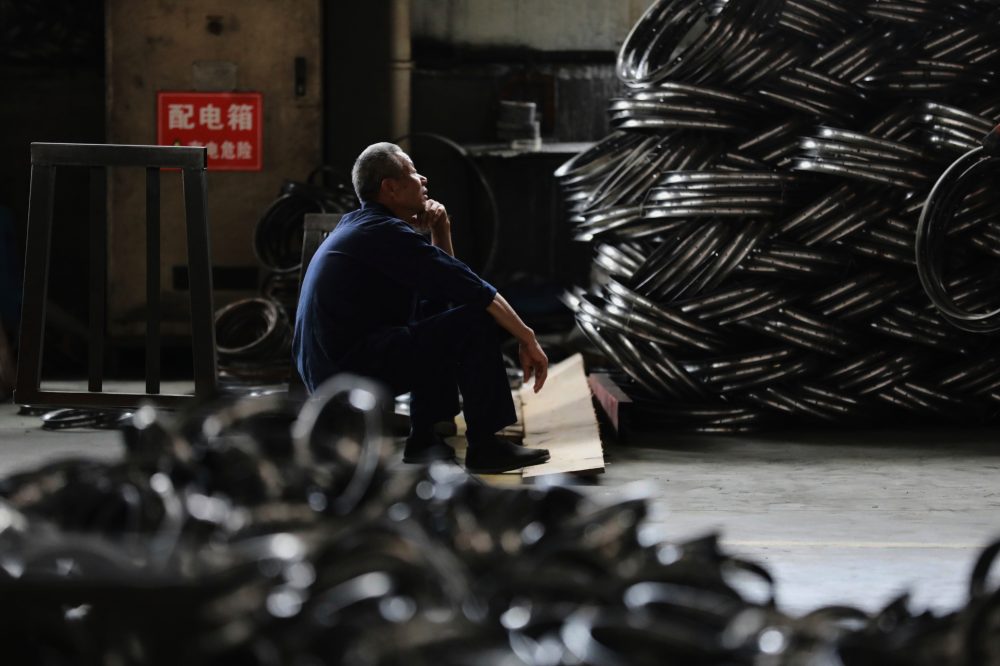
BEIJING (AP) — China’s factory activity was flat in May, according to an official survey released Sunday, raising questions about how much further the country’s economy can shield itself from the fallout of the ongoing Iran war and pressure on demand.
The official manufacturing purchasing managers index moderated to 50 from 50.3 in April, according to the National Bureau of Statistics. Measured on a scale between 0 and 100, a PMI reading above 50 indicates expansion, while a reading below 50 reflects contraction.
The new orders sub-index dropped to 49.9 from 50.6 in April, while the sub-index on production edged down to 51.2 from April’s 51.5. The sub-index for raw material stockpiles fell to 48.6 from 49.3 in April.
China has been less affected by the global energy shock from the Iran war than many other countries, which face inflationary pressures as as oil prices have surged due to the closure of the Strait of Hormuz, through which a fifth of the world’s oil is shipped in peacetime.
Analysts say China’s ample oil reserves and diversified sources of energy have helped the world’s second-largest economy weather the war nearly unscathed.
“Though the energy crisis remains the dominant headwind for Asia, China is relatively more shielded given its robust energy security set-up,” Frederic Neumann, Chief Asia Economist at HSBC bank, wrote in a research note last week.
Meanwhile, exports remain key for China’s broader economy, HSBC said.
While China’s exports to the United States have dropped year-on-year during most months in the past year, its global exports have been robust, particularly to Europe and Southeast Asia.
Hopes for a recovery in exports to the U.S. have risen following President Donald Trump’s summit with Chinese leader Xi Jinping in Beijing in mid-May, and after the two countries agreed to set up separate boards of trade and investment.
Autos, technology and artificial intelligence-related exports have been helping to drive export growth, but some economists also point to concerns over the broader economy. Domestic demand remains sluggish in the wake of a years-long property sector slump that has clobbered consumer confidence and investment.
“Domestic demand is lagging, but high-end manufacturing and exports are holding the line,” Robin Xing, Chief China Economist at Morgan Stanley, wrote in a research note last week.
Chinese leaders have set an annual economic growth target of 4.5% to 5% for this year. That’s the lowest target since 1991, albeit only slightly lower than the “around 5%” target set in 2025.
Morgan Stanley said China will still likely meet its 2026 target, but oil prices and the easing of uncertainties around global oil supplies would be key factors determining where things might be heading.
Brought to you by www.srnnews.com