


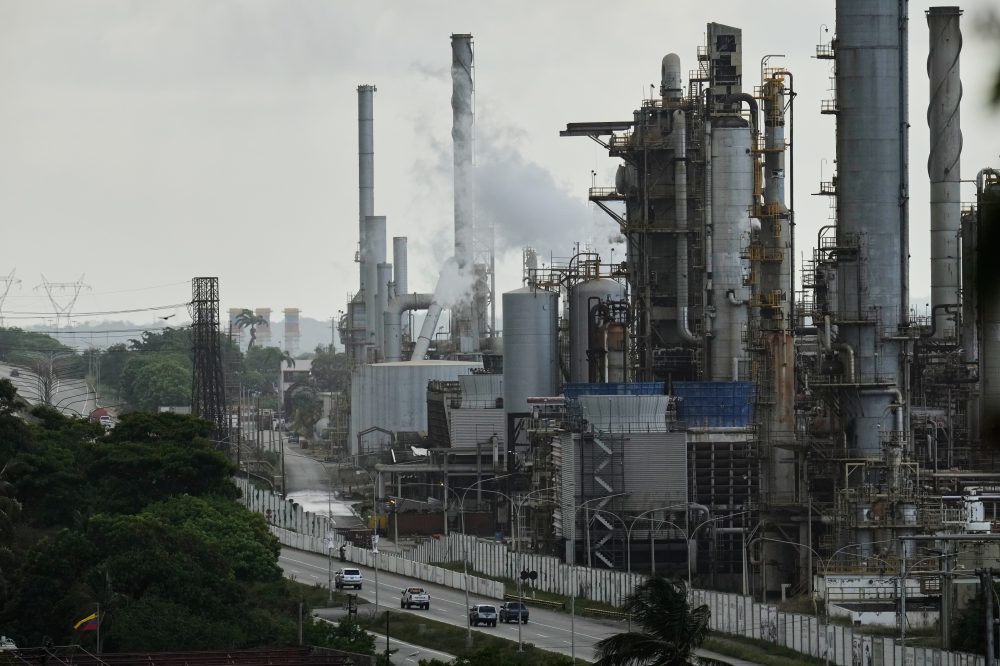
BOGOTA, Colombia (AP) — Environmental experts are warning that the U.S. push to revamp and boost Venezuela’s vast oil reserves could worsen decades of ecological damage and increase planet-warming pollution in a country already struggling with the legacy of a long-declining petroleum industry.
The warnings come as Washington has intensified pressure on Venezuela following the capture of former President Nicolás Maduro last weekend. Since then, the United States has moved to assert control over Venezuelan oil exports, the country’s main source of revenue, seizing tankers it says were transporting crude in violation of U.S. sanctions and signaling plans to redirect Venezuelan oil to global markets under U.S. oversight.
The Trump administration has said it plans to sell between 30 million and 50 million barrels of Venezuelan crude worldwide, though it has not specified a time frame. Proceeds would be held in U.S.-controlled accounts, which the administration says would benefit both Venezuelans and Americans.
Industry analysts caution that significantly expanding Venezuelan oil production would require years of investment and tens of billions of dollars to repair decaying infrastructure, raising questions about how quickly — or whether — Trump’s plans could realistically be carried out.
“You’ve got storage facilities literally sinking into the ground, broken wellheads and degraded infrastructure across the board,” said Paasha Mahdavi, an associate professor of political science at the University of California, Santa Barbara, who studies energy governance and political economy.
Venezuela’s oil reserves are thought to be the largest in the world at an estimated 300 billion barrels. The country, which stretches from the Caribbean coast into the northern Andes, is already highly exposed to oil pollution and ranks among tropical countries with the fastest deforestation rates, according to Global Forest Watch, an online monitoring platform hosted by the World Resources Institute. It produces heavy crude that emits significantly more pollution than most other forms of oil. That’s because it takes more energy to extract and refine, which often involves burning natural gas, mostly methane, a powerful greenhouse gas that heats the planet.
Reviving Venezuela’s oil industry would deepen environmental damage in a country already plagued by spills, gas leaks and dilapidated infrastructure, with higher output expected to boost climate emissions and increase spill risks in fragile ecosystems, several experts warned.
The Venezuelan Political Ecology Observatory, an environmental watchdog, documented nearly 200 oil spills from 2016 to 2021 that were largely unreported by authorities. Satellite data from Global Forest Watch, an online forest monitoring platform hosted by the World Resources Institute, show Venezuela has lost roughly 2.6 million hectares of tree cover — about the size of the U.S. state of Vermont — over the past two decades, largely driven by agriculture, mining and fires, though oil activity has contributed to forest loss in some producing regions.
According to a 2025 report by the International Energy Agency, the methane emissions intensity, or ratio of methane released to natural gas produced, was far above the norm in Venezuela’s oil and gas operations, with estimates showing upstream methane emissions roughly six times the world average. Flaring intensity, or volume of natural gas burned to oil produced, was about 10 times higher than typical global levels.
The White House referred questions by The Associated Press to the Department of Energy, which in a statement said U.S. oil and gas companies that would revamp Venezuela’s oil industry had “the highest environmental standards.”
“As American investment in Venezuela increases, you can expect environmental conditions to improve,” the statement said.
The dense and sticky Venezuelan crude is high in sulfur, making it harder to extract and refine than other oil, such as the lighter oil produced from U.S. shale fields, said Diego Rivera Rivota, a senior research associate at the Center on Global Energy Policy at Columbia University.
“It’s very dense, very sloppy, very hard. And it’s also very sour,” Rivota said. “What that means in practical terms is that it requires, versus other types of oil resources, higher infrastructure, higher use of energy – it’s much more energy intensive – and hence much more carbon intensive as well.”
Still, many U.S. refineries were designed decades ago to process that type of oil, making Venezuelan crude a good fit despite its higher processing demands.
Even a modest increase in Venezuelan oil production could carry climate consequences on the scale of entire countries, said Mahdavi, of the University of California, Santa Barbara.
Mahdavi said raising output by about 1 million barrels a day — a level often cited as a near-term goal — would add roughly 360 million metric tons of carbon dioxide a year from production. Pushing production further, to around 1.5 million barrels a day, could drive annual emissions to about 550 million tons, he said — comparable to the emissions from roughly half of all gasoline-powered vehicles in the United States.
“That’s just the production side,” Mahdavi told AP, noting that far larger emissions are generated when the oil is eventually burned by consumers.
Patrick Galey of nonprofit Global Witness said Venezuela’s oil system is among the most poorly maintained in the world after years of underinvestment, with aging pipelines, storage facilities and widespread gas flaring that heighten the risk of spills and methane leaks. He said any rapid push to expand production is likely to prioritize output over pollution controls, worsening climate and environmental damage.
Kevin Book, director of research at ClearView Energy Partners, said there could be efforts to make Venezuelan oil production more efficient, both economically and environmentally, with a significant amount of investment.
“The new investment will bring the latest technologies in methane capture and emissions management to bear, not just because of environmental goals, but because there’s a valuable resource to be captured and sold,” Book said. “And so for that reason, there’s actually some potential relative environmental upside compared to status quo, if you take the assumption that oil demand was going to grow anyway.”
In recent public remarks, U.S. officials have focused on control of oil sales, revenues and infrastructure repairs, without mentioning environmental safeguards or climate impacts. President Trump, both in his first and now second term, has repeatedly dismissed the scientific consensus on climate change and rolled back environmental and clean-energy policies.
In Caracas, Antonio de Lisio, an environmental professor and researcher at the Central University of Venezuela, said oil exploitation in the country has long gone hand in hand with environmental damage, leaving decades-old pollution that has never been fully addressed.
He said Venezuela’s heavy oil reserves lie in fragile plains crisscrossed by slow-moving rivers, a geography that can magnify the effects of spills.
“Any oil spill has the potential to worsen because these are not fast-moving rivers, they are slow-moving waters,” de Lisio said, referring to morichales — palm-swamp wetlands common in eastern Venezuela, where contamination can persist for long periods.
He said that energy-intensive processing plants that use heat, chemicals and large volumes of water to make heavy crude exportable pose added environmental risks, especially in fragile river systems.
Environmental damage has persisted even as oil production has declined, he said, pointing to Lake Maracaibo — a shallow lake in western Venezuela drilled for oil for more than a century — as one of the most heavily oil-polluted ecosystems in the world. He said spills and contamination have also affected other regions, including areas near the Paraguana refining complex and protected coastal parks such as Morrocoy, where pollution has devastated marine life and coral reefs.
The true environmental and social costs of Venezuela’s oil have never been fully calculated, de Lisio said.
“If those costs were fully accounted for, we would see that continuing to produce oil is not the best business for Venezuela.”
___
Associated Press writer Alexa St. John contributed from Detroit.
___
The Associated Press’ climate and environmental coverage receives financial support from multiple private foundations. AP is solely responsible for all content. Find AP’s standards for working with philanthropies, a list of supporters and funded coverage areas at AP.org.
Brought to you by www.srnnews.com