


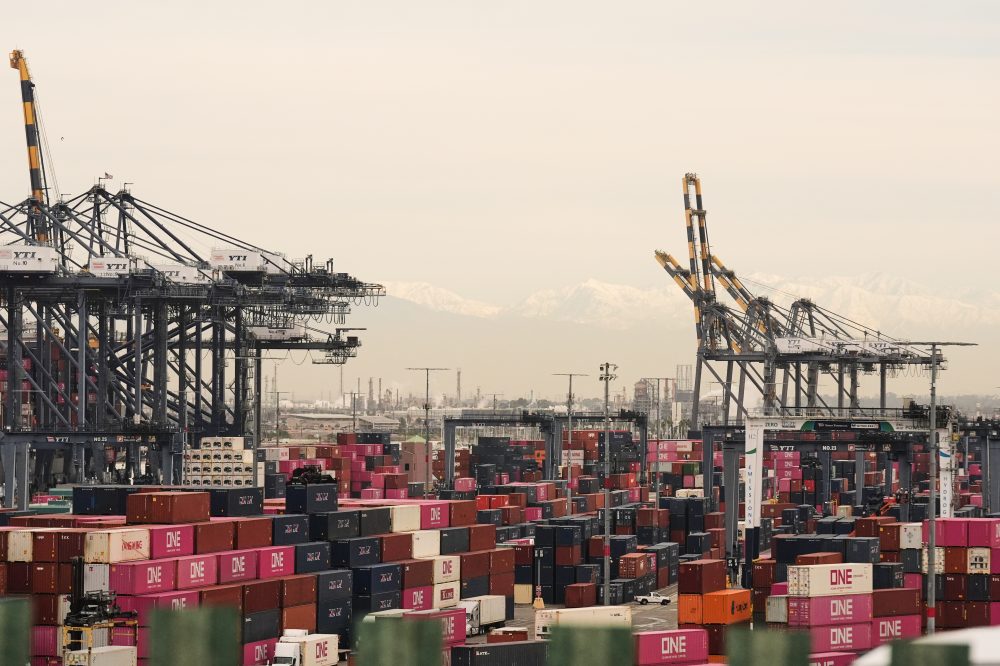
NEW YORK (AP) — As the U.S. and Israel’s war against Iran continues to upend energy markets and supply chains worldwide, the Trump administration says it might suspend maritime shipping requirements under a more than century-old law known as the Jones Act.
The Jones Act requires that goods hauled between U.S. ports be moved on U.S.-flagged vessels. Passed in 1920, this law aims to protect the American shipping sector — but it’s also faced criticism over the years for slowing the delivery of goods, including critical aid during time of crisis. And it’s often blamed for making gas, in particular, more expensive.
The White House confirmed that it was looking into waiving Jones Act requirements this week, in a temporary measure that would arrive amid wider efforts to counter steep oil prices and cargo disruptions due to the war.
Here’s what we know.
The Jones Act’s official name is the Merchant Marine Act of 1920. Congress passed the law — sponsored Sen. Wesley Jones of Washington state — in an effort to rebuild U.S. shipping after German U-boats decimated America’s merchant flee during World War I.
Among other things, the Jones Act mandates that ships carrying cargo and passengers between U.S. ports must be built in the United States and owned by Americans — effectively prohibiting foreign-flagged ships from this domestic trade. The vessels are also required to carry U.S. crews.
The law can be waived in the “interest of national defense,” the U.S. Maritime Administration notes, either through the Homeland Security or Defense Department.
The Jones Act also was intended to ensure that the U.S. had its own merchant fleet in case of war. It’s been strongly supported by some U.S. shipping companies, national security advocates and organized labor. But cutting out foreign competition has also driven up the cost of carrying cargo domestically.
U.S.-flagged ships are generally more expensive to both operate and build than foreign ones. And those costs are especially damaging to states and territories that are supplied by sea, such as Hawaii and Puerto Rico.
Oil prices have spiked and swung rapidly since the start of the Iran war — which has effectively halted tanker movement in the key Strait of Hormuz and led major oil producers across the Middle East to cut production. Commercial ships — which, beyond fuel, haul cargo from pharmaceuticals to computer chips — have also been stalled at sea or faced attacks themselves.
That’s pushing up prices for businesses and consumers worldwide. Crude oil is now trading around $100 a barrel, up from roughly $70 before the war began. And in the U.S., drivers have already seen prices at the pump jump — with the national average for regular gasoline sitting at around $3.63 a gallon on Friday, per AAA, up 69 cents from a month ago.
All of this has left countries scrambling for more supply and alternative shipping routes. And on Friday, when asked if he would consider suspending the 1920s Jones Act, President Donald Trump said “we’ll take a look at everything.”
In an interview on Fox News Radio, Trump called the Jones Act a “restrictive act” but also acknowledged it has “tremendous support” in Congress. The president’s comments arrived after White House press secretary Karoline Leavitt confirmed Thursday that the administration was looking into a temporary waiver to “ensure vital energy products and agricultural necessities are flowing freely to U.S. ports.”
Neither specified a timeline.
Many factors contribute to prices at the pump. Opening up domestic shipping routes to foreign-flagged vessels may bring some relief in the form of expanding transportation options, but it isn’t a sweeping fix.
The Center for American Progress estimates that waiving the Jones Act would decrease East Coast gas prices by a modest three cents, but potentially raising costs on the Gulf Coast. And the move “would also sideline American shipbuilders and workers and allow the oil industry to continue to profit from high prices while reducing transport costs,” the research and policy think tank said Friday.
The U.S. has actually become a top producer of crude oil — now exporting more petroleum than it imports. Still, oil is traded globally. And countries worldwide are working on other efforts to counter soaring prices.
Late Thursday, the Treasury Department announced it would take another step to free up Russian oil from U.S. sanctions for its war on Ukraine, granting a license to waive those sanctions for a month. That builds on a move last week to give India temporary permission to buy Russian oil.
Earlier this week, the International Energy Agency also pledged to release 400 million barrels of oil available from its member nations’ stockpiles, the largest volume of emergency oil pulled in the organization’s history. Trump previously downplayed the need to tap into reserve oil, but on Wednesday confirmed that the U.S. would pull 172 million barrels from its Strategic Petroleum Reserve over 120 days as part of the IEA’s effort.
Still, analysts maintain the release will be short-term bridge. And it takes time for new supply to trickle down to consumers. Refineries also buy crude oil in advance, so it’s possible the pain of higher prices could increase further if the war drags on. Even if more oil were withdrawn from the reserve, they could also be working with more expensive supply for a while.
_______
AP Writers Paul Wiseman and Collin Binkley in Washington contributed to this report.
Brought to you by www.srnnews.com