
By Jamie McGeever
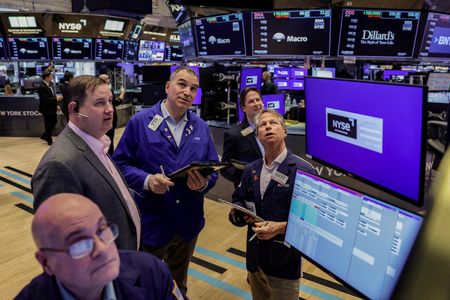
ORLANDO, Florida, March 30 (Reuters) – The S&P 500 and Nasdaq hit seven-month lows and bond yields fell on Monday as the Iran war entered its fifth week, with investors increasingly spooked by growth fears over inflation concerns even though oil prices rose further above $100 a barrel.
In my column today I look at why the spike in market-based borrowing costs since the Iran war broke out could not have come at a worse time for “Big Tech”, which is increasingly turning to debt to finance its unprecedented AI investment binge.
If you have more time to read, here are a few articles I recommend to help you make sense of what happened in markets today.
1. Trump again warns Iran to open Strait of Hormuz 2. Powell says Fed can “wait and see” how war affectsinflation 3. Fed’s faith in anchored inflation expectations may becoming under stress 4. Iran war volatility strains trading in world’s biggestmarkets 5. Japan steps up yen intervention threats, signalsrate-hike chance
Today’s Key Market Moves
* STOCKS: Asia slumps – Japan -3% – but Europe rises, withSTOXX 600 +1% and Britain’s FTSE 100 +1.6%. Wall Street mostlylower – Nasdaq and S&P 500 lowest since August. * SECTORS/SHARES: Only three of 11 sectors in the S&P 500fall, but their weight carries – tech -1.5%, industrials -1.6%,energy -0.9%. Sysco -15%, Micron Technology -10%. * FX: Dollar rises to highest since May last year. Euroslides on growth fears, yen rebounds on intervention warnings. * BONDS: U.S. yields down 7-9 bps. 2s/10s curve steepensfor a second day to 53 bps, the steepest in two weeks. * COMMODITIES/METALS: Brent +1% and WTI +4%, gold +0.5%,LME aluminum jumps 4%.
Today’s Talking Points
* No quarter given
The first quarter draws to a close on Tuesday, and it has been a wild ride. Brent crude oil is up 85%, its biggest rise since 1990; the U.S. “Magnificent 7” megacaps are down 17%, meaning they’ve lost almost 20% from the October high and are now close to a bear market; gold is still up despite March being its second-worst month in over 40 years.
In some ways, markets have been remarkably calm in light of the damage done to the global energy complex. 17% of Qatar’s gas capacity is offline; 20% of global oil and gas flows are choked off by the closure of the Strait of Hormuz; several Middle East countries, including Saudi Arabia, have shut energy production fields or refineries. Maybe markets have been too calm.
* A “good place”?
Where is monetary policy, the economy, labor market or bilateral trade relations if not in a “good place”? It seems to be officials’ favorite phrase, with European Central Bank President Christine Lagarde virtually turning it into a policy communications signal last year.
On Monday, Fed Chair Jerome Powell said U.S. policy is in a “good place”, and officials can “wait and see” how the energy and supply shocks affect both sides of the bank’s dual mandate. Powell was one of the first officials to coin the phrase in January last year, a time when some might argue the economy actually was in a “good place”.
* The art of the deal
Despite rising borrowing costs, heightened uncertainty and increased market volatility sparked by the Iran war, the flow of multi-billion-dollar deals and M&A activity has not stopped. On Monday, Sysco said it would buy catering supplier Jetro Restaurant Depot in a $29 billion deal.
Unilever is in talks to sell its foods business to McCormick & Company in a deal that would be worth over $30 billion, and earlier this month a consortium led by BlackRock’s Global Infrastructure Partners and Sweden’s EQT AB bought U.S. power company AES Corp for $33.4 billion. Deals are still being done.
What could move markets tomorrow?
* Developments in the Middle East * Energy market moves * Reserve Bank of Australia publishes minutes of Marchmeeting * Japan retail sales (February) * Japan unemployment (February) * Japan industrial production (February) * Japan Tokyo CPI inflation (March) * China “official” PMIs (March) * India trade, current account (Q4) * Germany retail sales (February) * Germany unemployment (March) * Euro zone inflation (March, flash estimate) * European Central Bank board member Patrick Montagnerspeaks * UK GDP (Q4) * U.S. house prices (January) * U.S. consumer confidence (March) * U.S. Chicago PMI (March) * U.S. “JOLTS” job openings (February) * U.S. Federal Reserve officials scheduled to speak includeChicago Fed President Austan Goolsbee, Kansas City Fed PresidentJeffrey Schmid, Governor Michael Barr, Vice Chair forSupervision Michelle Bowman
Want to receive Trading Day in your inbox every weekday morning? Sign up for my newsletter here.
Opinions expressed are those of the author. They do not reflect the views of Reuters News, which, under the Trust Principles, is committed to integrity, independence, and freedom from bias.
(Reporting by Jamie McGeever; Editing by Nia Williams)
Brought to you by www.srnnews.com