

BEIRUT (AP) — This time felt different.
The 25-year-old Iranian fashion designer hoped that mass protests nearly four years ago — the ones that erupted after a young woman was arrested and died in custody for not wearing the hijab properly — would improve civil rights in the Islamic Republic.
Not much changed, though. Being on those streets, she felt, may have been for nothing. But it didn’t deter her.
In early January, she protested again. The sea of people across Tehran’s busy streets lifted her spirits. This time, the spark was inflation and the plummeting value of the Iranian rial — though chants soon targeted the country’s theocratic leaders.
The crowd was larger, more diverse, she said. Protests in Iran erupt every few years. But this momentum felt unprecedented, she said.
The response by security forces would be, too.
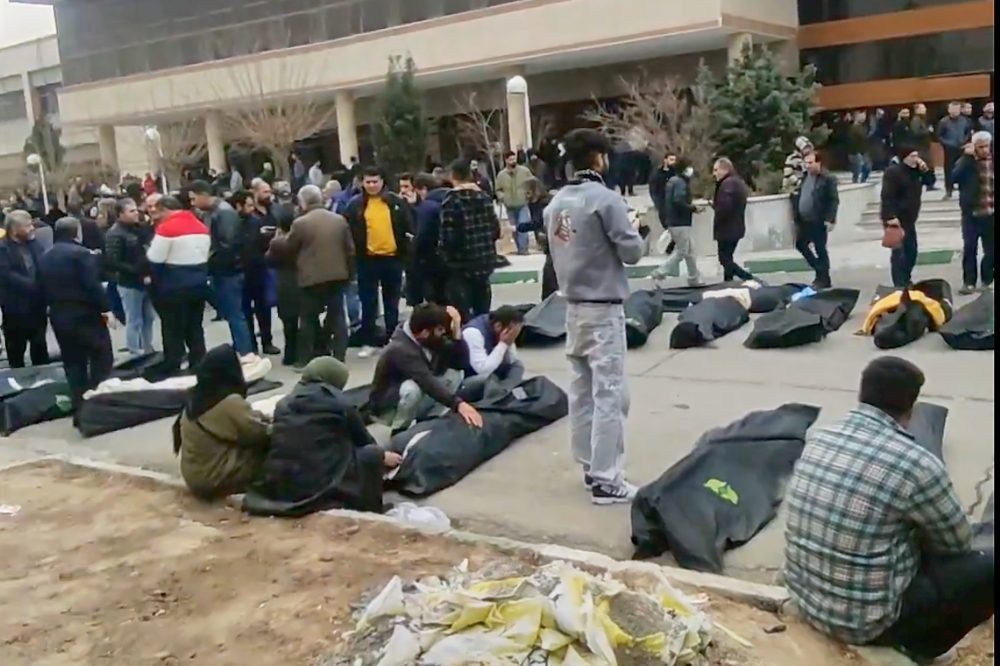
Activists estimate that over 6,000 people, mostly protesters, were killed in the bloodiest crackdown on dissent since the Islamic Republic was created in 1979. They worry the number will increase as information trickles out.
The Associated Press spoke with six Iranians, each on condition of anonymity through secure channels as security forces continued to crack down on dissenters after the protests. They said they demonstrated and witnessed state violence against protesters. Four of them took risks to circumvent an internet shutdown to share what they saw, while two spoke from abroad.
They described a rare sense of hope among protesters, a consensus that the current status quo was no longer sustainable. The younger, more defiant generation was there, they said, but so were older residents, people from well-to-do families, even some children. All said they expected the state to respond aggressively but were horrified by the extent of the brutal crackdown.
“When we went out, I couldn’t say I wasn’t stressed, but there was no way I could stay at home,” the designer said. “I felt that if I stayed home — if anyone stayed home — out of fear, nothing would move forward.”
No group of interviews — no matter how illuminating — can reflect the experiences of an entire population or even a segment of it. They’re not representative of the large country of over 85 million people and its diverse ethnic and religious makeup. But these Iranians offer a rare glimpse of life in the Islamic Republic at a pivotal moment in its history.
Iran was battered by Israeli and U.S. jets during a 12-day war in June and has been under the grip of Western-led sanctions, compounding economic problems. People say the government has not responded to their concerns of economic mismanagement and interference in their personal lives. They want rights, they say. Dignity.
Supreme Leader Ayatollah Ali Khamenei has said several thousand have been killed — a rare admission that indicates the scale of the movement and the government’s response. Officials and state media repeatedly refer to demonstrators as “terrorists,” showing images of buildings and state property they say protesters have burned or damaged. Iran’s mission to the United Nations did not respond to questions from AP about these witnesses’ recollections. Iran’s U.N. ambassador, Amir Saeid Iravani, has previously said security forces “firmly and responsibly” confronted protesters, whom he called “violent separatists.”
During the peak of the protests, the fashion designer said, people poured into the streets of Tehran. She described the events of Jan. 8, a turning point in the mood and crackdown on demonstrations.
“When I was outside in the evening, the city was still and empty,” the fashion designer said. Then came a call to protest from Reza Pahlavi, the exiled crown prince. By 8 p.m., she said, she was in a sea of thousands — a crowd larger and more diverse than she’d ever seen.
“Everyone was afraid,” she said, but “they kept saying, ‘No, don’t leave. This time, we can’t leave it. We must not leave until they are over.” She and two friends who protested with her spoke to the AP using a Starlink satellite dish because of the internet blackout, devices now being seized by authorities there.
They marched up Shariati Street, a commercial road that connects some of northern Tehran’s most bustling neighborhoods to one of the country’s busiest bazaars. But shops were closed. The three said they sprayed graffiti and yelled anti-government chants at the top of their lungs.
They described teenagers and elderly people joining Iran’s regular dissenting voices in chants of defiance and anger. Some chants called for the death of Khamenei — a cry that can bring the death penalty.
Then came the security forces.
Anti-riot police and members of the paramilitary Revolutionary Guard’s all-volunteer Basij force arrived, the three friends said, blocking the road and lobbing tear gas and firing pellet guns into the crowd. Protesters panicked and scrambled as the stench of tear gas swept across the crowd.
The group told AP that many pushed forward, throwing rocks at the security forces. Some younger people, veterans of previous protests, donned scarves or masks to protect themselves and hide their identities, expecting a violent pushback.
The protesters built momentum. Some security forces that had arrived on motorcycles appeared to have retreated. But, the fashion designer said, the forces returned, charging at protesters. She knew she and her friends had to run.
They dashed into alleys and side streets, away from the chaos. Residents cheering on protesters had thrown rags and antiseptics from their windows as security forces fired pellets at the crowd.
Soon, tear gas canisters fell into the alley. The fashion designer remembered lessons from other protests: “I thought I’d kick it back,” she said, to protect the wounded. But as she did, she said, security forces were firing paintballs and pellets. She described being pierced in the hand and leg.
Fortunately, she said, her mask softened the blow of the paintball that hit the side of her face.
When protests reached her part of the country, the doctor said, she wasn’t surprised. But the extent was a different story.
“This had never happened before at this scale,” said the doctor in Mashhad, Iran’s second-largest city and home to an important Shiite shrine. She spoke to AP while visiting family abroad.
Days before a hospital night shift, the physician said, she had attended protests in the northeastern city, hearing gunfire from a distance and feeling tear gas burn her eyes. She saw graffiti on walls and buildings afire, even mosques believed to be used by government forces as rally points.
Once she clocked in at the hospital, Iranian security forces had escalated their response.
“I was not afraid for myself,” the doctor said. “I was afraid for others.”
She didn’t work in the emergency room but tried to see what was going on as ambulances and protesters delivered bodies. Colleagues told her 150 bodies were brought in that night. As she tried to move in closer, she managed a glimpse at some of them, she said: a boy and a young woman lying on stretchers, bearing gunshot wounds.
Security agents in the hospital, both in uniform and plainclothes, took over the command of the hospital emergency room, the doctor said. Doctors protested, she said of the colleagues’ account, but they were told to stop speaking or asking questions.
“They were standing over their (ER workers) heads with a gun, telling them not to touch (the wounded),” the doctor recalled of the experience relayed by one colleague. It was “as if they wanted those injured people to die on their own.”
Khamenei told the nation that the protesters were either collaborators working for American or Israeli intelligence agencies or misguided members of the public trying to sabotage the country. Authorities held a counterdemonstration showing people loyal to the country’s theocratic leadership.
Crackdowns continued. Momentum ebbed. Iran remains cut off from the world. For some, rage and grief over the violence have grown.
“What I fear is that these events will be treated as something ordinary by the world, that people will simply move on and no one will pay attention,” the doctor said. “The fact that the voices of so many of those who were killed never reaches anyone is truly the most painful thing for me.”
She described observing a family arrive at the hospital to retrieve the body of a relative— a young woman. Agents refused to hand over her body, the doctor said, unless the family gave them her national identification and let them identify her as a Basij volunteer and government supporter. An argument started, and her family was arrested, the doctor said, and the woman’s body was taken to the cemetery with the others.
The family said, “Our daughter was killed by your forces,” the doctor recalled. “I can’t get the picture of that day out of mind, even for an hour.”
As January comes to an end, tensions on the streets have cooled, the three Iranians in Tehran told AP. Some daily life peeks through. But everywhere they go, they said, they remain watchful — in case something sets it all off again.
They can’t connect with Iranians outside their circles because of the internet blackout, but in their area, they said they see large deployments of security forces in public places.
“I don’t know how the other places are,” one of the three said. “But on every square in Tehran, there are agents in plain clothing — and even riot police.”
The doctor said she hopes the world won’t turn away from Iran.
“No matter how many times I explain, I truly can’t really convey the extent of the horrible situation,” she said. “No one would believe that a government of a country can so easily kill its own people.”
Brought to you by www.srnnews.com