

Laiba Ejaz, from Sargodha in Pakistan’s Punjab province, was found dead on Friday, October 9, at a weekly market in Islamabad’s G-10 sector. Police said her body was found hanging from a tree, with a traditional scarf tied around her neck.
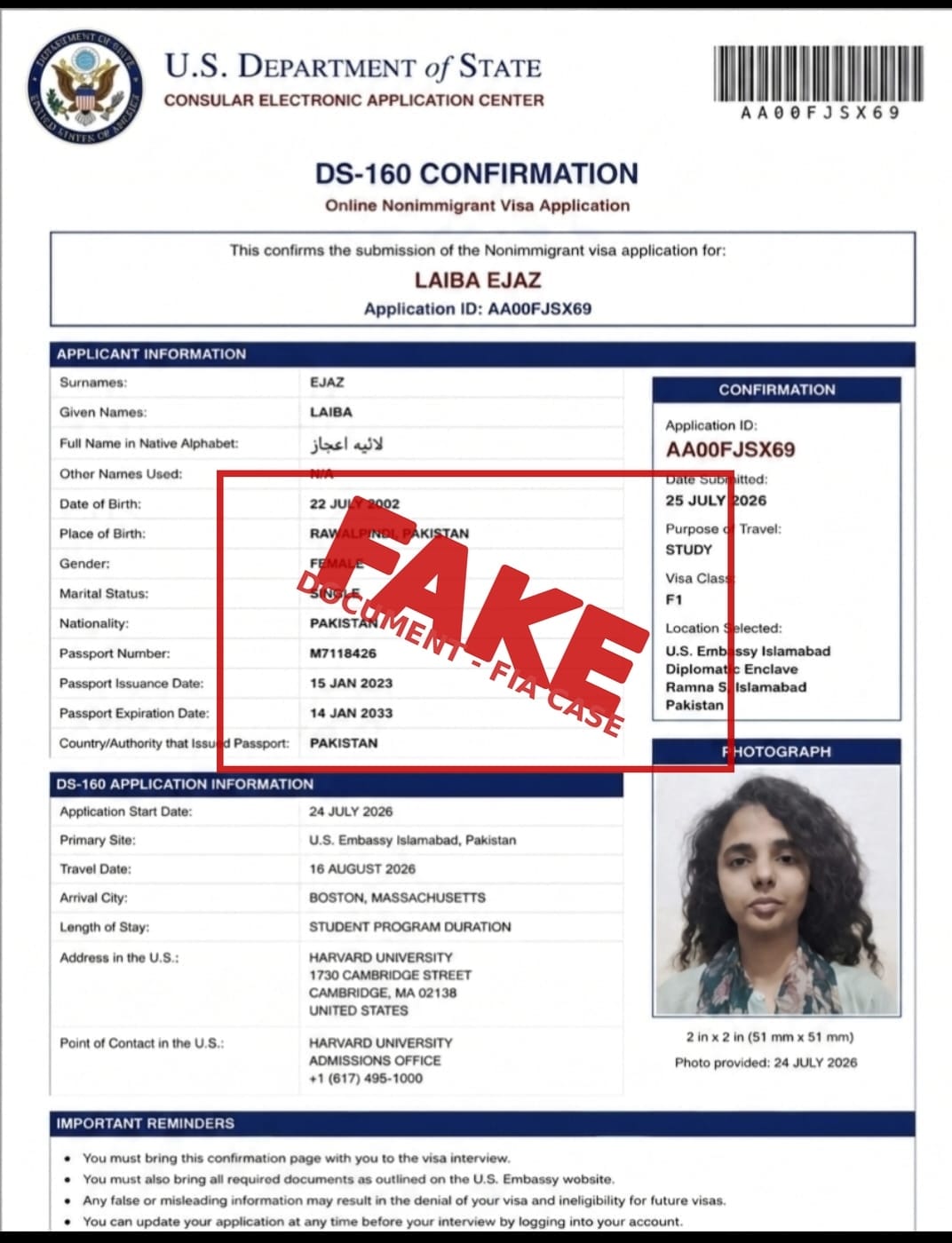
Investigators are examining allegations that two suspects defrauded Ejaz and her family of 9.3 million Pakistani rupees (around $34,000) by promising to secure her admission to Harvard University, along with a scholarship and a US visa. The suspects allegedly supplied forged admission letters, scholarship documents, and payment receipts.
Prime Minister Shehbaz Sharif ordered a thorough investigation, describing Ejaz’s death as “extremely tragic” and instructing Islamabad Police to arrest those responsible and ensure “exemplary punishment,” according to a statement from the Prime Minister’s Office.
Following his directive, Interior Minister Mohsin Naqvi and Minister of State for Interior Talal Chaudhry visited the bereaved family on Saturday. Islamabad Police and the Federal Investigation Agency (FIA) launched investigations into the circumstances surrounding her death and the alleged fraud.
According to preliminary findings obtained by The Media Line, 2.9 million rupees was transferred through Ejaz’s bank account, while the remainder was paid in cash. Investigators believe the alleged deception caused severe psychological distress before her death.
Ejaz had earned a gold medal in physics from the International Islamic University Islamabad and hoped to continue her education in the United States before pursuing a scientific career.
Her family said she had been searching for an overseas education consultant when she met Muhammad Nauman, who claimed he could arrange her university admission, scholarship, and visa.
After receiving payments from the family, Nauman allegedly produced a forged Harvard admission letter. According to officials, the document was rejected when Ejaz appeared for a visa interview at the US Embassy in Islamabad.
Her family said she became increasingly distressed as questions emerged about the authenticity of the documents and the whereabouts of the money.
The financial sacrifice behind her academic ambitions was considerable.
Her father, Ejaz, has sold milk and yogurt on the streets of Islamabad since 1994. Although he did not complete primary school, he was determined that his four daughters would receive an education through the master’s degree level.
Laiba, the youngest of his seven children, hoped to follow her eldest sister, who received a scholarship to study in China and now works as a translator for a major Chinese company in Lahore.
To finance Laiba’s plans, her father sold a plot of land he had purchased to build a family home. Her mother pawned her jewelry to help meet the consultant’s financial demands, according to relatives.
The family said Ejaz had previously been offered a scholarship to study in Saudi Arabia through her university but declined because she was determined to pursue higher education in the United States.
On Saturday, the FIA registered a criminal case against Nauman and an alleged female accomplice, Fatima Sarwar, following a complaint filed by Ejaz’s maternal uncle, Amjad Ur Rehman.
A copy of the first information report (FIR) obtained by The Media Line alleges that the pair, acting with other individuals, deceived the family through the fraudulent scholarship and visa arrangement. In Pakistan, an FIR is a formal police record of an alleged crime that sets the criminal investigation in motion.
Law enforcement sources told The Media Line that Nauman was arrested during a late-night raid in Islamabad’s H-13 sector, where he had reportedly been staying in a rented room to avoid detection.
Investigators reportedly recovered material from his mobile phone suggesting possible involvement in other online fraud schemes and the blackmail of women. Those allegations remain under investigation.
Sources also alleged that Nauman had previously been dismissed from his position with the Anti-Corruption Department in Quetta over accusations of fraudulent activities.
FIA Director Gen. Usman Anwar characterized the case as an impersonation scam rather than a conventional education consultancy fraud. He said the alleged female accomplice had falsely presented herself as Nauman’s contact in the United States.
Rehman, a lawyer and the complainant in the case, told The Media Line that Nauman had claimed to have access to scholarship and financial sponsorship documents through a woman named Aiza, purportedly based in the United States.
Believing those assurances, the family proceeded with the application process. However, as Nauman’s conduct became increasingly suspicious, relatives began checking the authenticity of the documents.
Rehman said the family contacted Harvard University directly and made inquiries through its own contacts at the US Embassy in Islamabad. Neither institution could verify the documents supplied to Ejaz, he said.
Zaid bin Afzal, Ejaz’s brother-in-law, told The Media Line that Nauman had repeatedly postponed her visa interview. On three or four occasions, he allegedly contacted her the night before a scheduled appointment to inform her that it had been canceled.
During his final conversation with Ejaz, Nauman reportedly claimed that another interview had been scheduled for October 12 and demanded payment of the remaining 2.2 million rupees before that date.
By then, Afzal said, Ejaz had discovered the alleged deception and was deeply distressed.
On October 9, she left home without informing her family where she was going. Before leaving, she had been online with her elder sister, Afzal’s wife, while her laptop remained at home.
Afzal said Ejaz contacted him shortly before her death and pleaded with him not to reveal the alleged fraud to her father.
“Don’t tell my father about the fraud committed against me; otherwise, he will die,” she said, according to Afzal.
He said Ejaz had concealed Nauman’s final demand for money from other family members.
Afzal later went to the market in Islamabad’s G-10 sector, where he said he discovered her body. He alerted police, who removed the body and transported it to a hospital.
The case has renewed concerns about fraudulent consultants targeting Pakistani families seeking educational opportunities abroad.
Pakistan’s FIA has investigated several cases involving forged university admission letters, scholarship documents, visas, and other paperwork used to exploit prospective students and their families.
In a separate recent investigation, the agency’s Anti-Corruption Circle raided education consultancy and courier offices in Islamabad and arrested 22 people, including six officials from the Ministry of Foreign Affairs.
The suspects allegedly produced or used counterfeit apostille stickers, forged stamps, and fraudulent documents while charging substantial fees for expedited services and paying bribes to facilitate the process. Authorities said the counterfeit authentication stickers had circulated across Pakistan, potentially causing financial losses to the national treasury.
Media reports have also alleged that unofficial channels collected approximately 12 billion rupees ($43 million) over one year to process roughly 800,000 documents, raising further questions about oversight of document authentication and overseas application services.
Bilal Ranjha, an education consultant based in Lahore, told The Media Line that many young Pakistanis seeking opportunities at Western universities turn to questionable intermediaries in the hope of bypassing standard admission requirements.
He said the desire for shortcuts had created opportunities for fraudulent and unqualified consultants to charge exorbitant fees for forged documents and promises they could not fulfill.
Ranjha estimated that 90% of young people who seek such shortcuts resort to falsified paperwork, although he did not provide supporting data for that estimate.
He also alleged that some individuals involved in fraudulent operations had connections to embassy employees, either through direct employment or personal contacts. The allegations were not independently verified.
Ranjha emphasized that legitimate applicants seeking admission to universities in the United States and Europe can use established procedures without relying on questionable intermediaries. Universities generally communicate admission decisions and send official documents directly to applicants, he said, allowing students to verify offers through recognized institutional channels.
Naheed Khan, an Islamabad-based youth rights activist, told The Media Line that Ejaz’s death should be understood in the context of Pakistan’s wider economic and institutional difficulties rather than viewed solely as the alleged misconduct of one consultant.
Khan said poverty, unemployment, and limited opportunities at home were putting increasing pressure on young Pakistanis, many of whom see overseas education and employment as a path toward financial security and a better future.
She called for stronger enforcement of existing laws, more effective regulation of overseas education consultants, and public policies aimed at protecting students and their families from exploitation.
Khan also questioned whether the institutions responsible for overseeing education consultancy services were providing adequate safeguards for young people pursuing opportunities abroad.
Brought to you by www.srnnews.com