


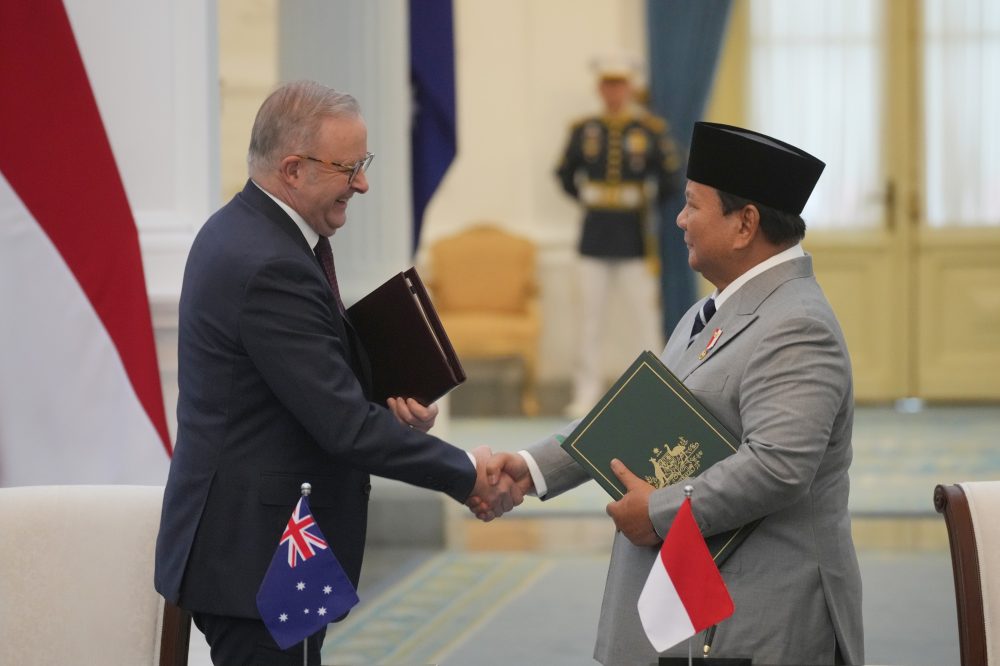
JAKARTA, Indonesia (AP) — Indonesian and Australian leaders signed a new bilateral security treaty Friday that both governments say will deepen ties between the often-testy neighbors.
The treaty was signed in Indonesia’s capital, Jakarta, three months after Australian Prime Minister Anthony Albanese and Indonesian President Prabowo Subianto announced in Sydney that negotiations on the pact had been substantively concluded, highlighting their ambition to better utilize the two country’s past security agreements inked in 1995 and 2006.
Albanese has cast the agreement as a “watershed moment” in relations with its major closest neighbor, saying in a statement ahead of his arrival in Jakarta late Thursday, that it marks a major extension of existing security and defense cooperation and reflects a relationship “as strong as it has ever been.” He is traveling with Foreign Minister Penny Wong, who called it the most important step in the partnership in three decades.
Analysts said the treaty is becoming increasingly important to Australia in face of growing tensions with China in the region. However, it is expected to echo elements of a 1995 security agreement inked between then-Prime Minister Paul Keating and Indonesia’s former authoritarian President Suharto — Prabowo ‘s former father-in-law.
That agreement committed both nations to consult on security issues and respond to adverse challenges, but was terminated by Indonesia four years later following Australia’s decision to lead a peacekeeping mission into East Timor. The two countries improved their security relationship over the next decade by signing a new treaty in 2006, known as the Lombok Treaty, which they expanded on in 2014.
Susannah Patton from the Lowy Institute, a Sydney-based international policy think tank, said the agreement, whose text has not been published, is largely about the political commitment to consult. She described it as a “symbolic agreement,” noting the 2024 defense cooperation accord was more focused on practical military collaboration.
Patton said the new treaty sits below Australia’s alliance with the United States and the security agreement signed with Papua New Guinea in terms of obligations. She did not expect to find clarity in the agreement on whether Indonesia would come to Australia’s defense in the event of a security threat in the region.
“So it’s very much not a mutual defense treaty because I think that would not be politically acceptable to Indonesia as a non-aligned country,” Patton said.
Despite that, she praised the agreement as a huge success for Albanese, because not many people would have predicted this kind of agreement would be possible with Indonesia as a non-aligned country with “a very big difference between the way that Australia and Indonesia see the world.”
She said that Australia has very much taken advantage of the fact that the Southeast Asia country is now under Prabowo, a president who is really much more willing to break with Indonesian foreign policy tradition and to strike leader-led agreements.
Albanese’s office framed the visit as his fifth official trip to Indonesia and part of a broader push to expand cooperation beyond security into trade, investment, education and development.
Albanese is scheduled to meet Prabowo and Indonesian officials through Sunday before returning to Australia.
Although Indonesia, a vast archipelago nation of more than 280 million people, is often presented as one of Australia’s most important neighbors and strategic allies, the relationship has undergone various ups and downs. Recent disagreements include allegations of wiretapping by the Australian Signals Directorate to monitor the private phone calls of Indonesia’s former President Susilo Bambang Yudhoyono, his wife and other senior officials, as well as Indonesia’s execution of Australian drug smugglers, and cases of people smuggling.
___
Associated Press writer Rod McGuirk in Melbourne, Australia, contributed this report.
Brought to you by www.srnnews.com