

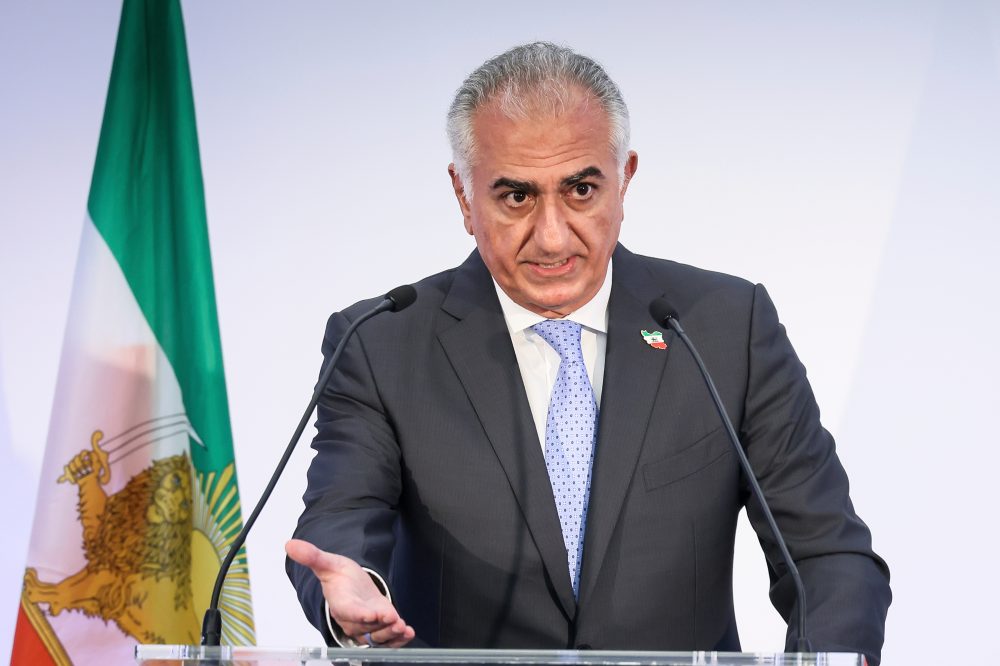
DUBAI, United Arab Emirates (AP) — He has been in exile for nearly 50 years. His father — Iran’s shah — was so widely hated that millions took the streets against him in 1979, forcing him from power. Nevertheless, Iran’s Crown Prince Reza Pahlavi is trying to position himself as a player in his country’s future.
Pahlavi successfully spurred protesters onto the streets Thursday night in a massive escalation of the protests sweeping Iran. Initially sparked by the Islamic Republic’s ailing economy, the demonstrations have become a serious challenge to its theocracy, battered by years of nationwide protests and a 12-day war in June launched by Israel that saw the U.S. bomb nuclear enrichment sites.
What is unknown is how much real support the 65-year-old Pahlavi, who is in exile in the U.S., has in his homeland. Do protesters want a return of the Peacock Throne, as his father’s reign was known? Or are the protesters just looking for anything that is not Iran’s Shiite theocracy?
Pahlavi has issued calls, rebroadcast by Farsi-language satellite news channels and websites abroad, for Iranians to return to the streets Friday night.
“Over the past decade, Iran’s protest movement and dissident community has been increasingly nationalist in tone and tenor,” said Behnam Ben Taleblu, an Iran expert with the Washington-based Foundation for Defense of Democracies, which faces sanctions from Tehran.
“The more the Islamic Republic has failed, the more it has emboldened its antithesis. … The success of the crown prince and his team has been in drawing a sharp contrast between the normalcy of what was and the promise of what could be, versus the nightmare and present predicament that is the reality for so many Iranians.”
Pahlavi’s profile rose again during President Donald Trump’s first term. Still, Trump and other world leaders have been hesitant to embrace him, given the many cautionary tales in the Middle East and elsewhere of Western governments putting their faith in exiles long estranged from their homelands.
Iranian state media, which for years mocked Pahlavi as being out of touch and corrupt, blamed “monarchist terrorist elements” for the demonstrations Thursday night during which vehicles were burned and police kiosks attacked.
Born Oct. 31, 1960, Pahlavi lived in a gilded world of luxury as the crown prince to Shah Mohammad Reza Pahlavi.
Mohammed Reza had inherited the throne from his own father, an army officer who seized power with support from the British. Mohammed Reza’s rule was cemented by a 1953 CIA-backed coup, and he cooperated closely with the Americans, who sold the autocratic ruler billions of dollars of weapons and spied on the Soviet Union from Iran.
The young Pahlavi was schooled at the eponymous Reza Pahlavi School, set up within the walls of Niavaran Palace in northern Tehran. A biographer of his father noted the crown prince once played rock music in the palace during a New Year’s Eve visit to Tehran by then-U.S. President Jimmy Carter.
But the fall of the Peacock Throne loomed.
While successfully riding rising oil prices in the 1970s, deep economic inequality set in during the shah’s rule and his feared SAVAK intelligence agency became notorious for the torture of dissidents.
Millions across the country participated in protests against the shah, uniting secular leftists, labor unions, professionals, students and Muslim clergy. As the crisis reached a fever pitch, the shah was doomed by his inability to act and poor decisions while secretly fighting terminal cancer.
In 1978, Crown Prince Reza left his homeland for flight school at a U.S. air base in Texas. A year later, his father fled Iran during the onset of what became known as the Islamic Revolution. Shiite clerics squeezed out other anti-shah factions, establishing a new theocratic government that executed thousands after the revolution and to this day remains one of the world’s top executioners.
After his father’s death, a royal court in exile announced that Reza Pahlavi assumed the role of the shah on Oct. 31, 1980, his 20th birthday.
“I can understand and sympathize with your sufferings and your inner torment,” Pahlavi said, addressing Iranians in an 11-minute speech at the time. “I shed the tears which you must hide. Yet there is, I am sure, light beyond the darkness. Deep in your hearts you may be confident that this nightmare, like others in our history, will pass.”
But what followed has been nearly five decades in exile.
Pahlavi attempted to gain influence abroad. In 1986, The Washington Post reported that the CIA supplied the prince’s allies “a miniaturized television transmitter for an 11-minute clandestine broadcast” to Iran by Pahlavi that pirated the signal of two stations in the Islamic Republic.
“I will return and together we will pave the way for the nation’s happiness and prosperity through freedom,” Pahlavi reportedly said in the broadcast.
That did not happen. Pahlavi largely lived abroad in the United States in Los Angeles and Washington, D.C., while his mother, the Shahbanu Farah Pahlavi, lived in Paris.
Circles of diehard Iranian monarchists in exile have long touted dreams of the Pahlavi dynasty returning to power. But Pahlavi has been hampered in gaining wider appeal by a number of factors: bitter memories of his father’s rule; the perception that he and his family are out of touch with their homeland; and repression inside Iran that aims to silence any opposition sentiment.
At the same time, younger generations in Iran born decades after the shah’s rule ended have grown up under a different experience; social restrictions and brutal suppression by the Islamic Republic and economic turmoil under international sanctions, corruption and mismanagement.
Pahlavi has sought to have a voice through social media videos, as well as Farsi-language news channels like Iran International highlighting his calls for protests. The channel also aired QR codes that led to information for security force members within Iran to cooperate with him.
In interviews in recent years, Pahlavi has raised the idea of a constitutional monarchy, perhaps with an elected rather than a hereditary ruler. But he has also said it is up to Iranians to choose.
“This regime is simply irreformable because the nature of it, its DNA, is such that it cannot,” Pahlavi told The Associated Press in 2017. “People have given up with the idea of reform and they think there has to be fundamental change. Now, how this change can occur is the big question.”
He has also faced criticism for his support of and from Israel, particularly after the June war.
“My focus right now is on liberating Iran, and I will find any means that I can, without compromising the national interests and independence, with anyone who is willing to give us a hand, whether it is the U.S. or the Saudis or the Israelis or whomever it is,” he said in 2017.
Brought to you by www.srnnews.com