

By Naomi Rovnick
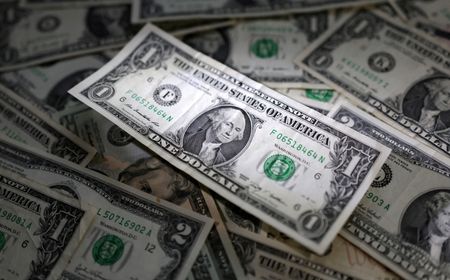
LONDON, Feb 3 (Reuters) – The dollar, the world’s No.1 reserve currency, is having a rocky ride as unpredictable White House policy moves and Federal Reserve independence concerns revive “Sell America” trades.
While it is expected to weaken further, sudden rebounds in the greenback can catch traders out just as much as sudden sharp falls.
Having fallen almost 2% in one week in January to four-year lows, an index measuring the dollar’s value against other major currencies then bounced back, causing metals market mayhem.
Here’s a look at how dollar risks are rippling through world markets.
1/ METALS MELTDOWN
The dollar’s rebound in the last two trading sessions, following U.S. President Donald Trump’s decision to nominate former Federal Reserve governor Kevin Warsh to replace outgoing Fed chief Jerome Powell has sparked a metals market meltdown.
Gold, which had notched up its best month in more than half a century in January, slumped 5% on Monday after its biggest daily fall since the early 1980s in the prior session – though it regained some ground on Tuesday.
Traders had crowded into a popular currency debasement trade that relied on metals prices rising as Fed independence kept the dollar on a steady weakening path. That concept then dropped out of metals markets “at lightning speed,” days, Societe Generale said in a client note.
Silver and copper also fell sharply from recent all-time peaks, while Brent crude oil is set for its worst week in almost two months after rallying 16% in January.
2/ WILDER CURRENCY SWINGS
The almost $10 trillion-a-day global currency market has become more volatile.
A gauge of the most actively traded currency pair — the euro/dollar exchange rate — that measures expected volatility in three months’ time, hit its highest since July last week.
According to Capital Economics, the dollar had become detached from traditional valuation metrics like the gap between U.S. and Japanese or European interest rates.
Barclays has calculated a U.S. policy risk premium for the dollar, meaning it is influenced by White House rhetoric and has become partly detached from the economic and growth forecasts that investors usually track. That could make stocks and bonds priced in dollars harder for foreign investors to hold and value.
“The main question is whether people lose confidence in the U.S. asset base,” said Barclays global head of FX and EM macro strategy Themos Fiotakis.
3/ SELL AMERICA?
Foreign investors own almost $70 trillion-worth of U.S. assets, more than doubling their holdings in the last decade as Wall Street stocks boomed. European money managers are assessing their exposures.
A weaker dollar can boost U.S. stocks by increasing the local currency value of companies’ overseas earnings and often raises prices of Treasuries.
“But disorderly (dollar) decline could change this relationship,” Bank of America analysts said in a note.
A disorderly drop would be a 5% monthly loss, BofA said, which could generate a “drastic sell-off of long-dated Treasuries,” and tighten U.S. financial conditions significantly.
A wider debasement trade, with the dollar falling in tandem with domestic assets, was also a risk, BofA said.
4/ TAKE COVER NOW
Janus Henderson multi-asset manager Oliver Blackbourn said that he was shifting his portfolios towards a neutral stance to back away from market risk and had cut his exposure to stocks and gold in the last two weeks.
“If the dollar is more volatile on the back of various (policy) pronouncements then other assets are going to volatile on the back of that, so we’ll just have to get more neutral in the short term.”
John Stopford, head managed income at Ninety One, said he had bought both put options that make money if Treasury yields rise and call options that pay out if they fall.
This was “to cover the uncertainty over the likely direction of yields from here,” he said.
Hedge funds, meanwhile, are backing out of North American assets because of trade tensions and policy uncertainty.
(Reporting by Naomi Rovnick, Editing by Dhara Ranasinghe and Aidan Lewis)
Brought to you by www.srnnews.com