


LOS ANGELES (AP) — The economic fallout from the war with Iran is driving up the cost of buying a home, even as other housing market trends in many parts of the country favor home shoppers this spring.
Mortgage rates have been rising since the war began, as surging energy prices heighten worries about higher inflation, pushing up the yield on U.S. 10-year Treasury bonds, which lenders use as a guide to pricing home loans.
As recently as the last week of February, the average rate on a 30-year mortgage dropped to just under 6%, its lowest level in more than three and a half years. It climbed this week to 6.46%, its highest level in nearly seven months.
The conflict is also injecting more uncertainty into the U.S. economic outlook at a time when the job market is sputtering.
While rates are still down from a year ago, their recent upward trend has already led to a slowdown in mortgage applications. Further increases threaten to put a damper on home sales during what’s traditionally the busiest time of the year for the housing market.
“The war in Iran has seriously complicated the spring buying season,” said Joel Berner, senior economist at Realtor.com. “I expect that many buyers will be put off by rising rates and mounting economic uncertainty, choosing to bide their time rather than jumping on board for a purchase before rates go up.”
Home shoppers who can afford to buy at current mortgage rates this spring are likely to find a more buyer-friendly housing market than this time last year. That means they’ll have more leverage when negotiating with sellers, who in many cases are watching their property go unsold for weeks, potentially making them more willing to lower their initial asking price or offer buyers money for closing costs, repairs or other concessions in order to get a deal done, real estate agents say.
In the Dallas-Fort Worth metro area, lower listing prices and more homes on the market are forcing many sellers to price their home more competitively or consider offering some incentives to land a buyer, said Matthew Crites, an agent with Coldwell Banker Realty.
“It’s been a really good buyer’s market to kind of start the year off with,” he said.
The trends helped give home shopper Anne King a strong hand when she set her sights on a three-bedroom, two-bath ranch-style house in Fort Worth listed at $275,000.
The contract administrator offered $10,000 below the listing price. She also asked that the seller kick in $5,000 toward closing costs. The seller accepted, and later agreed to throw in another $12,000 for repairs after a home inspection revealed roof damage.
“Fortunately for me, the seller was in a position they needed to sell,” said King, 57. The purchase was finalized in late February, just before the start of the conflict in the Middle East.
King had hoped mortgage rates would ease further before she bought the home, but decided it made sense to buy sooner, rather than risk having to compete this spring against more homebuyers who could potentially trigger a bidding war — something she experienced last May when she bought a two-bedroom, two-bath townhouse in Arlington, Texas.
She locked in a 6% rate on her mortgage and plans to refinance to a lower rate whenever rates drop.
“I feel like I got a good deal on this property, and that’s all that matters,” she said.
While the inventory of homes for sale nationally is still low by historical standards, active listings — a tally that encompasses all homes on the market except those pending a finalized sale — jumped nearly 8% in February from a year earlier, according to data from Realtor.com.
The increase varies across the U.S., with the West, Midwest and South far outpacing the Northeast. Still, some 43 of the 50 largest metro areas had more homes for sale in February than a year earlier, with listings up between 10% and 38.5% in many markets, including Seattle, Indianapolis, Las Vegas and Houston and Denver.
As homes take longer to sell, prices have started falling. The median listing price was down in February from a year earlier in just over half of the nation’s biggest 50 metro areas, including a nearly 9% drop in Austin and Memphis, and declines of more than 5% in Washington D.C., San Diego and Los Angeles.
In another sign that buyers may have the edge negotiating with sellers this spring, an analysis by Redfin estimates that there were about 46% more sellers than prospective buyers in the market nationally in February. That’s up from about 30% a year earlier and represents the largest gap between buyers and sellers on records going back to 2013, according to Redfin.
Miami, Nashville and Austin are among the metro areas where sellers most outnumber buyers, Redfin found.
The U.S. housing market has been in a sales slump since 2022, when mortgage rates began to climb from pandemic-era lows. Sales of previously occupied U.S. homes were essentially flat last year, stuck at a 30-year low. They have remained sluggish so far this year, declining in January and February versus a year earlier.
While the pace of home price growth has slowed or fallen in many metro areas, affordability hurdles remain daunting for many aspiring homebuyers because wage growth has not kept up with home prices.
Consider, the median price of an existing home sold in February was $398,000, according to the National Association of Realtors. That’s nearly five times the median household income. A historic rule of thumb was that homes generally cost three times the household income.
The recent increase in mortgage rates adds slightly to the affordability challenge. On a $400,000 home near downtown Dallas, for example, factoring in a 20% down payment and a 30-year mortgage at 6%, the buyer’s monthly payment would be about $2,248. At a 6.4% rate, that payment would climb to $2,331.
And while mortgage rates are still lower than a year ago, making monthly payments more manageable, rates are still much higher than the sub-3% averages available to homebuyers during most of 2020 and 2021 as the weakened economy dealt with the coronavirus pandemic and its aftermath.
The housing market has cooled considerably since earlier this decade, when rock-bottom mortgage rates set off a frenzy that sent home prices soaring. Back then, it wasn’t uncommon for a home to fetch well above the seller’s asking price after receiving offers from multiple buyers.
While some sellers are still receiving multiple offers now, it’s far from the norm.
Jo Chavez, a Redfin agent in Kansas City, tells clients looking to sell to expect that their home probably won’t sell right away. She also advises them to be “reasonable” with how they price their home.
“We have a lot of sellers who have that idea of like, ‘well, my neighbors sold for this much, and so I think I should price $10,000 above them,’” said Chavez. “And that’s obviously not a logical approach, because there were less sales last year.”
Kansas City is among the few metro areas where the median listing price isn’t falling. It rose 4.1% in February from a year earlier, according to Realtor.com. However, the number of homes on the market soared by nearly 20%.
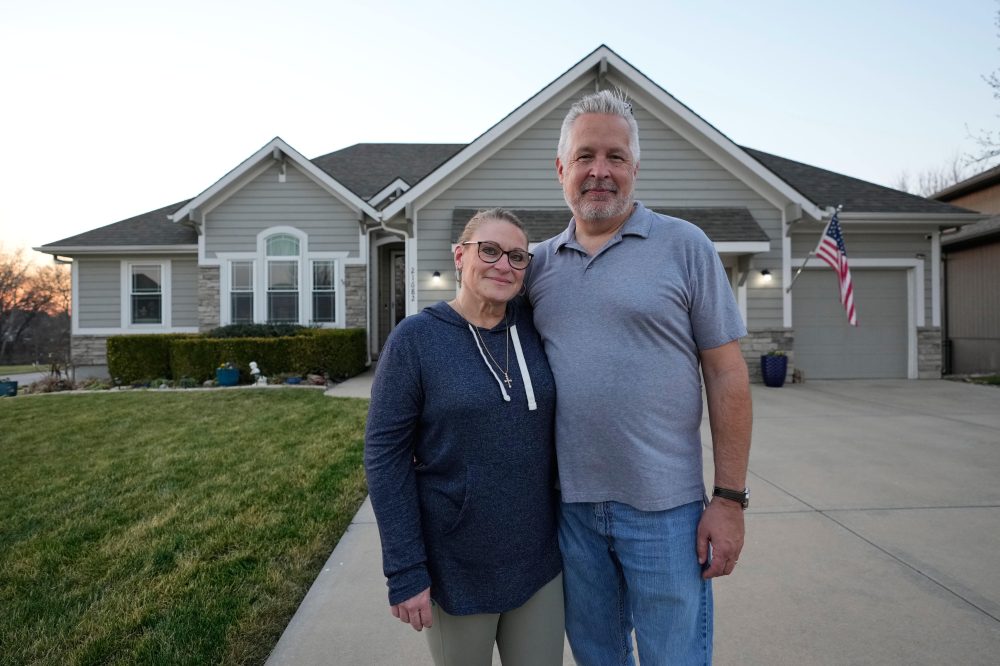
Gail Sanders and her husband, David, put their four-bedroom, three-bath home in Olathe, Kansas, on the market in late February. But even after hosting a couple of open houses, and after lowering their asking price from $535,000 to $525,000, the couple had yet to receive any offers as March drew to a close.
The couple wants to sell the house and buy a home in another Kansas City suburb closer to their three adult children and grandchildren. But until they find a buyer, those plans are on hold.
“We just didn’t think it was fair to somebody else to put a contingent offer on (another house), but then also lock ourselves into something when we weren’t sure how fast ours was going to move,” said Gail Sanders, a senior claims director. “I don’t want to be stuck with two house mortgages on the off chance.”
Brought to you by www.srnnews.com