


NEW YORK (AP) — Oil prices are easing and helping to calm Wall Street’s worries that inflation could potentially get even worse. That has U.S. stock indexes rising early Monday, but several major chip stocks are falling again including Micron and AMD. The S&P 500 rose 0.4%. The Dow Jones Industrial Average added 625 points, and the Nasdaq composite rose 0.2%. The price of a barrel of Brent crude fell 5.1% to $83.42 after President Donald Trump said over the weekend he would hold off on ordering new strikes against Iran at the urging of allies in the region. Treasury yields fell.
THIS IS A BREAKING NEWS UPDATE. AP’s earlier story follows below.
U.S. markets were poised to open with gains and oil prices fell sharply Monday after President Donald Trump said he would order U.S. forces to refrain from attacks against Iran and that a deal to end the fighting was near.
Futures for the S&P rose 0.6%, while futures for the Dow Jones Industrial Average climbed 1.1%. Nasdaq futures were up 0.3% before the opening bell Monday.
In Asia, Japan’s Nikkei 225 index lost 0.9% and the U.S. dollar dipped against the yen after the U.S. and Japan confirmed they had acted to prop up the value of the Japanese yen against the dollar.
The retreat in oil prices Monday was just the latest of many big swings since the U.S. and Israel attacked Iran in late February. On-and-off fighting and comments from Trump about which way the conflict was heading have been the major drivers of rising and falling oil prices.
Just a day before Trump said he would order the military to pull back on the aggression, the president said he was “losing faith” in the negotiations with Iran, warning that the U.S. military “will be hitting them very hard.”
Brent crude, the international standard, fell $4.27, or 4.9%, to $83.66 per barrel. U.S. benchmark crude lost $4.86, or 5.8%, to $79.81 per barrel.
Early Monday in Tokyo, after the official announcement of the U.S. and Japan’s currency intervention, the dollar fell to 155.20. The U.S. currency had risen to 40-year highs against the yen recently, last week trading near 164 yen.
By late Monday, a dollar bought 156.79 yen.
A weak yen helps to boost the profits of Japanese companies with big operations overseas, increasing their value in yen terms. It also has drawn millions of foreign tourists who have enjoyed their strong purchasing power in Japan.
But a cheap currency also weakens Japan’s purchasing power overall, pushing up costs for the imports of oil and other essential goods.
The dollar’s value has surged as it serves as a safe haven for investors in times of uncertainty, such as during war. Trump lauded the dollar’s strength in comments to reporters, but a weaker dollar can help make U.S. exports more competitive.
The U.S. Treasury bought yen through the Federal Reserve Bank of New York, analysts said, to help boost its value.
It’s a strong signal, said Stephen Innes of SPI Asset Management.
“Washington is no longer merely giving Tokyo permission to defend the yen. It is prepared to stand on the same side of the trade,” he said in a commentary.
In Asian trading, Japan’s Nikkei 225 index lost 0.9% to 63,754.90, while the Kospi in South Korea dropped 5.1% to 6,257.45.
The Kospi soared 17.9% on Friday for its best day in history after losing even more of its value earlier in the week. The index is dominated by two tech giants, Samsung Electronics and SK Hynix, both of whose shares gained more than 25% on Friday. Shares in both companies fell 8.8% on Monday.
Hong Kong’s Hang Seng index picked up 0.5% to 26,009.40 and the Shanghai Composite index lost 0.6% to 3,809.66.
In European markets at midday, Germany’s DAX gained 1.5%, while the CAC 40 in Paris climbed 1.1%. Britain’s FTSE 100 inched up 0.2%.
This week brings a slew of U.S. labor market data, highlighted by the government’s July jobs report on Friday.
Earnings season is also in high gear, with dozens of major companies reporting their latest profits, including Palantir, SpaceX, McDonald’s, The Walt Disney Co. and Uber, among others.
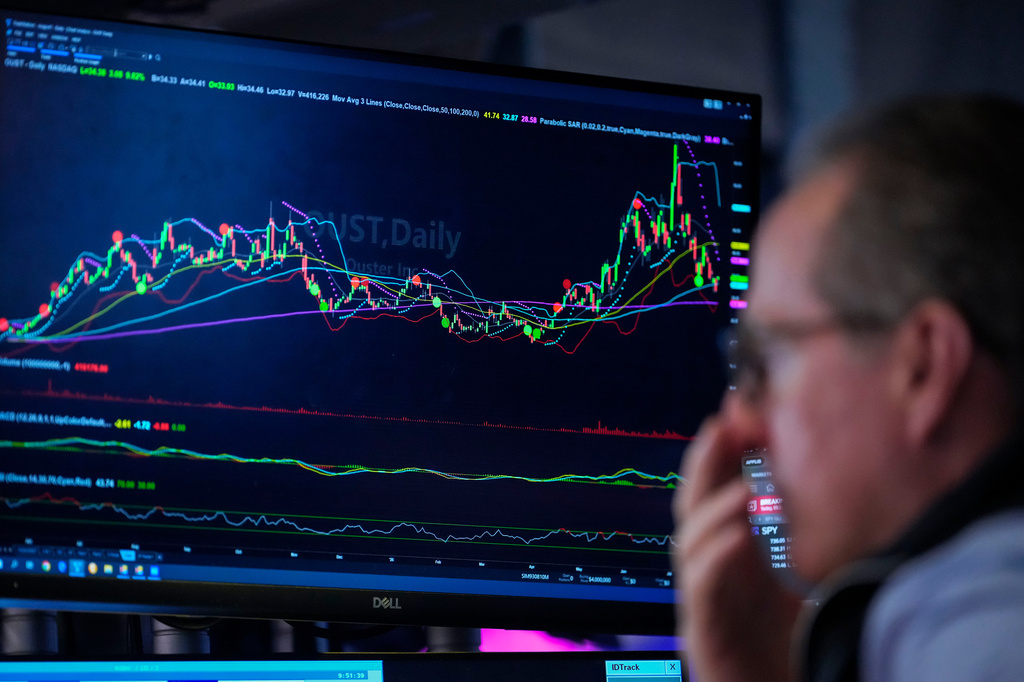
PHOTO- A trader works on the floor of the New York Stock Exchange, Thursday, July 30, 2026, in New York. (AP Photo/Yuki Iwamura)
Brought to you by www.srnnews.com