


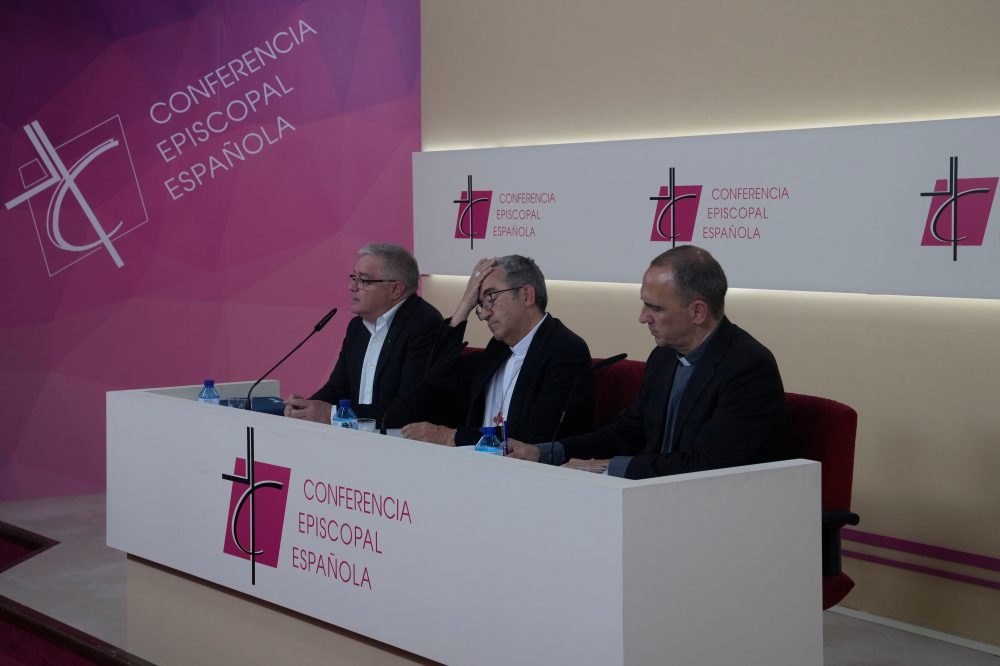
BARCELONA, Spain (AP) — Spain’s government and the country’s Catholic bishops agreed Thursday to a joint plan to compensate victims of sexual abuse by clergy members who have died or whose possible crimes have been proscribed.
The agreement aimed to resolve discrepancies between the left-wing government and church authorities over the question of reparations for abuse victims in the once staunchly Catholic country, which has secularized in recent decades.
The Spanish Episcopal Conference, run by the bishops, said in a statement that the new agreement will allow victims who don’t want to seek help directly from the church to turn to the government and the state’s ombudsman, who has taken a lead role in shedding light on abuse.
Spain’s Justice Minister Félix Bolaños said in a press conference in Madrid that “hundreds” of victims whose aggressors had passed away or were now very old could finally receive recognition of the abuse and receive economic reparations paid by the church.
“Today, we have paid a debt to the victims,” Bolaños said. “It is true that the State has acted late, but we are acting now. Yesterday, the victims couldn’t do anything because these crimes had proscribed.”
Only in the past decade has Spain begun to face the question of sexual abuse by the priesthood and other church members, mainly thanks to the initial reporting by newspaper El País.
In 2023, Spain’s ombudsman delivered a damning 800-page report that investigated 487 known cases of sexual abuse and included a survey that calculated the number of possible victims could reach the hundreds of thousands.
Spain’s bishops strongly refuted that estimate by the ombudsman, saying its own investigation had uncovered 728 sexual abusers within the church since 1945. It said that most of the crimes had occurred before 1990 and that 60% of the aggressors were now dead.
In 2024, the government announced its intention to force the church to compensate victims. That was followed a few months later by the bishops saying they were creating a special committee to hear from victims, assess their claims and ensure their “economic, spiritual and psychological” reparation.
But victims’ groups were critical of the bishops’ plan since it relied on them approaching the church and had no outside oversight.
On Thursday, Archbishop Luis Argüello, the president of the Spanish Episcopal Conference, acknowledged that some victims did not feel comfortable approaching the church offices.
Now, victims can turn to the government instead.
Under the new agreement, victims can approach Spain’s Justice Ministry with their initial petition. The ministry will pass it on to the ombudsman, who will study it and propose a compensation package that the church’s committee will then assess. If no agreement can be reached with the church and the victim, the case will go to a joint committee with representatives of the church, the ombudsman’s office and victims’ associations. If that committee can’t agree, the ombudsman’s decision will stand, Bolaños said.
The window for filing claims will be open for one year. After that, the agreement can be extended for an additional year if needed, according to Bolaños.
In addition to victims’ groups and the Spanish bishops, Bolaños thanked the work of late Pope Francis and Pope Leo XIV in uncovering abuse in the church.
Argüello said the church had already paid out 2 million euros ($2.3 million) in compensation after taking up petitions by more than a hundred victims since its special committee opened in 2024.
Payments to victims will be free of taxes in the new deal.
Only a handful of countries have had government-initiated or parliamentary inquiries into clergy sex abuse, although some independent groups have carried out their own investigations.
The issue of compensating victims of abuse has long vexed the church, with wide disparities in programs and payouts around the world. In the United States, where the abuse scandal erupted in 2002, litigation, settlements and abuse compensation programs have cost the church billions of dollars and led several dioceses to seek bankruptcy protection.
Elsewhere, church-run compensation programs have awarded smaller amounts to victims and paired financial reparations with services offering therapy and spiritual assistance. The French church, for example, paid out an average of about 35,000 euros ($41,000) to each of the 358 victims whose claims were received in 2023. Compensation awards were approved in 2024 for another 489 people, 88 of whom were given the maximum 60,000 euro ($70,000) claim, the church reported.
The Vatican’s child protection advisory board said in its report last year that the Catholic Church had a moral obligation to help victims heal, and that financial reparations for the abused, and tougher sanctions for the abusers and their enablers were essential remedies.
___
AP writer Nicole Winfield contributed to this report from Rome.
Brought to you by www.srnnews.com