
FRIA, Guinea (AP) — Kazaliou Balde’s parents started worrying about him when as a small child he avoided eye contact and had difficulty communicating.
First, the family in the West African nation of Guinea turned to a traditional healer who suggested protective amulets. Then, as the boy dragged himself along the ground instead of walking, they took him to a hospital in the capital, Conakry, where he was diagnosed with autism — something the family had never heard of before.
Neither had their neighbors. Some of them made rude comments about the child.
“Some suggested that I take him to the bush and throw him away,” said his mother, Kadiatou Diallo, a 55-year-old trader.
Misconceptions are common around children with autism in parts of Africa that lack reliable data, awareness and government support. Some mistakenly attribute autism to evil spirits. Experts say the misconceptions have often delayed diagnosis and brought stigma for children and their families.
Autism is a complex developmental condition now known as autism spectrum disorder that affects people in different ways. It can include delays in language, learning or social and emotional skills. For some people, profound autism means being nonverbal and having intellectual disabilities, but the majority of people experience milder effects.
Guinea’s government does not keep records around autism. The World Health Organization says about one in 127 people worldwide had autism in 2021, but it notes that the prevalence in many low- and middle-income countries remains unknown.
Diallo decided to stand up for her son and seek better care. She said she has four children but loves him especially “because I’ve suffered so much with him.”
In Guinea, a nation of about 15 million people, only a few schools cater to children with autism and they can cost up to $300 per month. Not many families can afford it in a country where the minimum wage is 550,000 Guinea francs ($63) a month, and where 43.7% of citizens live below the poverty line, according to the World Bank.
“In Guinea, the care for autism is very poor,” said Dr. Alhassane Cherif, a psychologist and clinician in Conakry. “Private organizations and nonprofits are the only ones addressing this disorder and training staff to try to identify children.”
Balde first attended both private and public schools, but none fit him. His teachers did not introduce him to writing and reading, his mother said, recalling their comments that her son “has no provision for school.”
“I refused to consider these negative judgments. I refused to take him out of school,” Diallo said.
She said her late husband “went to every corner of the country” looking for assistance for their son before dying in a road accident.
The solution appeared in their own hometown.
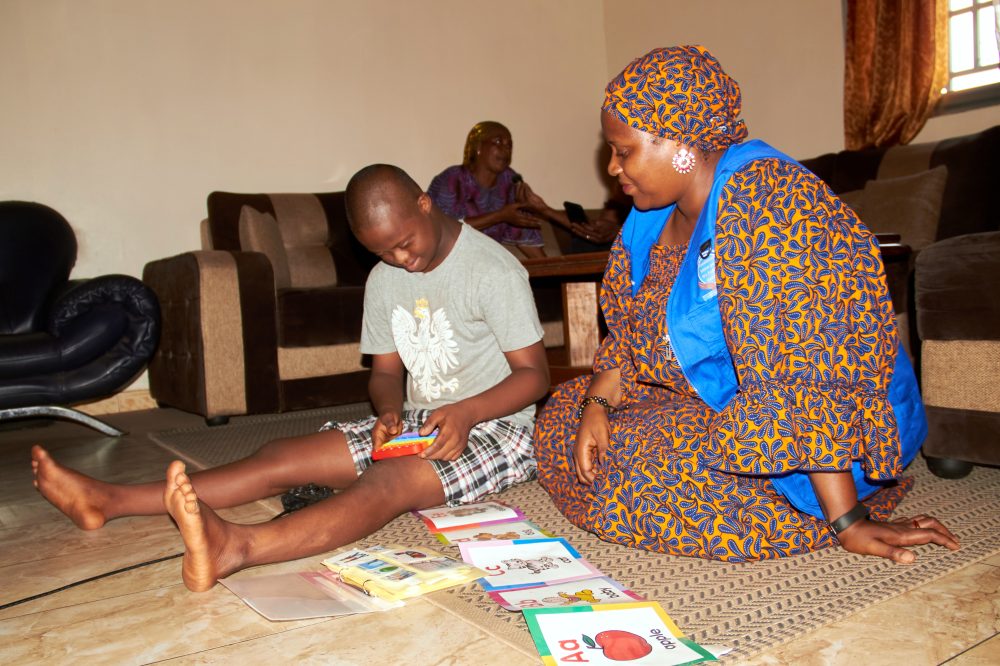
In 2023, Balde enrolled in the newly opened Salim Foundation for Children with Autism, a rare free school for children with autism. The school’s authorities were conducting an outreach program when they learned of Balde and visited his family.
The school teaches him and 14 other students in a large house with three teachers. It has toys in bright colors and pictures of animals on the walls.
The school, registered with Guinea’s educational authorities but not receiving government funding, is the brainchild of Mariam Aisha Barry, a social worker and philanthropist who said her daughter with autism was her inspiration.
At the school, children are taught basic things like identifying objects and assembling toys as well as everyday skills such as operating a TV remote.
Last year, the school organized what it called the country’s first international seminar on autism.
“Our mission is to break the stigma surrounding autism through awareness-raising, family training and advocacy for better care. These children deserve acceptance, understanding, education and unconditional love,” Barry said.
Still, the now-15-year-old Balde has had to spend his life outside school away from many community members because they still attribute his condition to an unknown “evil” and want him shunned.
“I categorically refused,” his mother said.
Studies on autism are often conducted in high-income countries, with less attention to places like Guinea. That makes it difficult to identify risk factors or plan effective intervention strategies, experts say.
Sub-Saharan Africa is “critically understudied” in autism research, according to a 2023 study in the Review Journal of Autism and Developmental Disorders, which said the region’s “rich genetic diversity” could improve understanding of autism globally.
The gap has kept many parents from seeking help.
“We have 15 autistic children here, but there are several hundred in this city. Some parents hide them in their homes to avoid mockery and stigmatization,” said Hassanatou Diallo, advocacy officer at the Salim school.
Balde’s mother said that despite the challenges, she will not give up on her son’s education.
“My most ardent wish is that he knows how to read and write,” she said. ___
For more on Africa and development: https://apnews.com/hub/africa-pulse
The Associated Press receives financial support for global health and development coverage in Africa from the Gates Foundation. The AP is solely responsible for all content. Find AP’s standards for working with philanthropies, a list of supporters and funded coverage areas at AP.org.
Brought to you by www.srnnews.com