

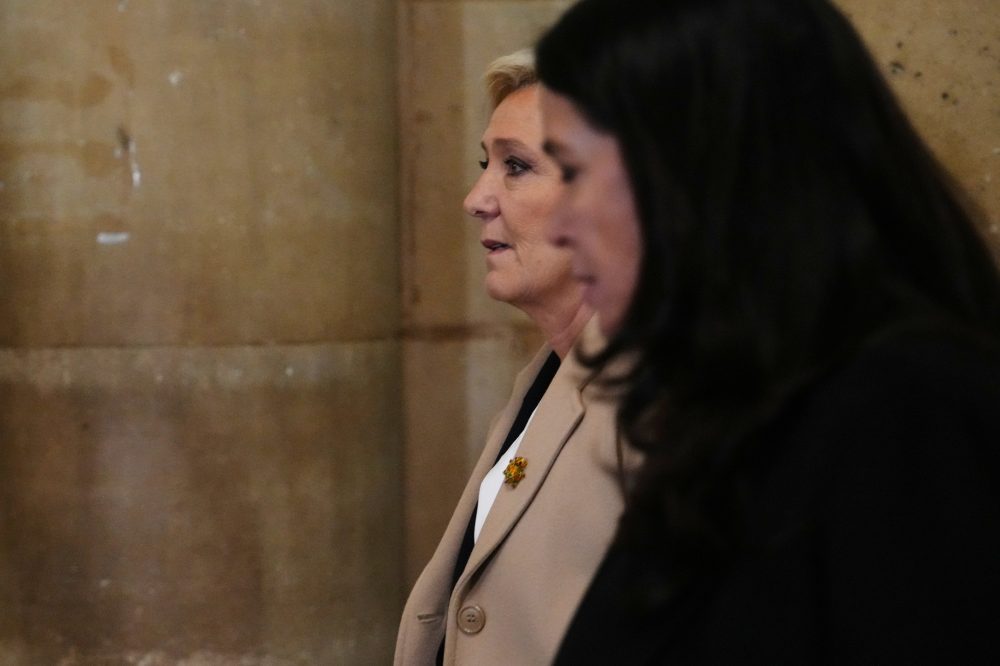
PARIS (AP) — Marine Le Pen’s appeal trial over alleged misuse of European Parliament funds is ending Wednesday with one question looming above all others: will the French far-right leader be able to run for president next year?
Le Pen, 57, is challenging a March 2025 verdict that found her and over 20 other members of her National Rally party guilty of misusing European Parliament funds in the hiring of aides from 2004 to 2016 and banned her from holding elected office for five years.
She denies accusations she was at the center of a fraudulent system meant to siphon off European Union funds.
The outcome of the appeals trial will be announced at a later date, likely before summer.
Here’s why the outcome of the five-week trial at the Paris appeals court may change the course of France’s 2027 presidential election.
Le Pen was widely seen as a top contender to succeed centrist President Emmanuel Macron in the 2027 election until a Paris court banned her from holding office over charges of misusing public money.
She was twice a contender in the run-off against Macron in 2017 and 2022 and her National Rally party has been coming out on top in opinion polls in recent years.
The appeals trial is a second chance to win an acquittal that would clear her path to the presidential race.
If convicted, Le Pen could be sentenced to a ban on holding an elected office. In that case, she has said, her 30-year-old protege Jordan Bardella would run instead.
Bardella’s popularity has surged in recent years, but some observers have pointed to his relative lack of experience, especially with international and economic affairs, as a potential weakness for a presidential bid.
Le Pen is joined in her appeal by 10 other officials who were convicted last year, as well as the party itself.
They’re seeking to overturn convictions for misusing funding meant for European parliament aides between 2004 and 2016, while Le Pen was serving as a member of the European parliament.
Prosecutors say she hired several people as EU parliamentary aides but made them work for her party instead. The investigation showed some of the people had no contact with members of the EU parliament at all, and one acted as Le Pen’s bodyguard in violation of parliamentary rules.
In March 2025, a Paris court ruled that Le Pen was at the heart of “a fraudulent system” that her party used to siphon off EU Parliament funds worth 2.9 million euros ($3.4 million). She was given a five-year ban from holding elected office, two years of house arrest with an electronic bracelet, and a further two-year suspended sentence.
Le Pen denounced a “democratic scandal,” while anti-corruption campaigners argued that her conviction was proof that no one is above the law.
Advocacy group Transparency France noted that the verdict came after years of investigation and a lengthy trial in which Le Pen and other party members were able to freely defend their positions.
House arrest sentences are on hold until the appeal is resolved.
The earlier verdict is not expected to influence the trial that ends Wednesday, which began afresh. In France, criminal defendants have the right to ask a higher court to re-hear their case after conviction.
During the appeal trial, Le Pen acknowledged some employees paid as EU parliamentary aides performed work for her party, then known as the National Front, but insisted that she believed such work was allowed and never attempted to hide it.
“The mistake lies here: there were certainly some aides, on a case-by-case basis, who must have worked either marginally, more substantially, or entirely … for the benefit of the party. And voilà,” Le Pen told the three-judge panel.
She also reproached EU Parliament officials not warning her party, at the time, that the way it was hiring people was potentially against any rules.
“We have never concealed anything,” she insisted.
Prosecutors argued the financing of employees by EU money was unfair to other domestic political parties and that Le Pen, a lawyer by training, could not have failed to notice the discrepancy between aides’ actual jobs and the contracts they signed.
One prosecutor, Stéphane Madoz-Blanchet, pointed to “public money siphoned off drop by drop until it formed a river.” He denounced “a system” led by Le Pen.
“The acts of misappropriation of public funds were deliberately and carefully concealed,” he said.
Thierry Ramonatxo, another prosecutor, said the alleged misappropriation of public funds represents “a very serious breach of probity” that gave the party “a concrete advantage in the form of substantial savings made at the expense of the European Parliament.”
They have asked the court to ban Le Pen from holding elected office for five years and to sentence her to one year under house arrest with an electronic tag.
Brought to you by www.srnnews.com