


By Kevin Yao
BEIJING, Jan 21 (Reuters) – China is planning to introduce new measures to promote the consumption of services, betting that elderly care, healthcare and leisure can offset tepid demand for goods, though analysts say the plan’s success hinges on elevating household incomes and social welfare.
Beijing views labor-intensive services as a key to reorienting its economy toward consumption as it tries to wean itself off a traditional dependence on big-ticket investment and exports.
Authorities are likely to unveil incentives, ease market barriers and invest in high-growth sectors to tackle supply gaps, but deeper reforms to elevate incomes and strengthen the safety net are critical, policy advisers and analysts say.
In contrast to China’s manufacturing sector – where supply often exceeds demand – the services sector faces chronic shortages because of underdevelopment and years of policy bias towards factories.
“Policymakers are placing greater emphasis on services consumption given its big potential,” said a policy adviser who requested anonymity because they were not authorised to speak publicly. “But expanding the sector will be a gradual process, aligned with the pace of economic transformation.”
Chinese leaders have vowed to “significantly” lift household consumption’s share of the economy over the next five years. Most policy advisers believe China should lift its share to 45% by 2030, up from roughly 40% at present.
Leaders have vowed to “invest in people” by boosting spending on education, healthcare and social security – a signal of stronger support for families and a push to lift household spending power.
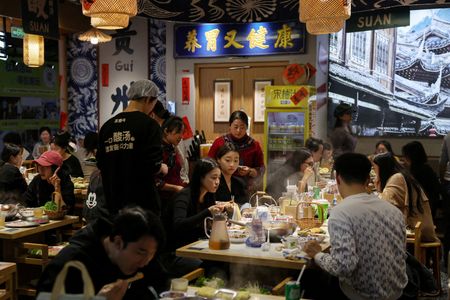
Chinese households are channelling more spending into services – from elderly care to travel and entertainment – as demand for big-ticket goods plateaus. Most families appear to have sufficient supplies of goods and per-capita GDP is nearing $14,000. The shift underscores China’s move toward a services-led consumption model.
“Rebalancing itself is more a matter of the relative importance of consumption and investment in the economy, rather than whether consumption takes the form of goods or services,” said Fred Neumann, chief Asia economist at HSBC.
“That said, as household incomes increase with economic development and as households become older, the demand for services should grow faster than that for goods.”
China’s economy grew 5% last year, matching the government’s target, by seizing a record share of global goods demand to offset weak domestic consumption, a strategy that blunted the impact of U.S. tariffs.
Retail sales of goods grew just 0.9% in December from a year earlier – the slowest since December 2022. Factory output rose 5.2% from a year earlier.
Services sales climbed 5.5% in 2025, higher than the 3.7% growth for goods.
Per-capita services consumption reached 46.1% of total spending in 2025, up from 40.3% in 2014 when official data first became available.
China’s household consumption is about 20 percentage points of GDP below the global average, while its investment share is roughly 20 points higher. China accounts for around 30% of global manufacturing output, the largest share of any country.
“It is completely realistic to boost the household consumption rate, but it depends on the level of policy commitment,” said Lynn Song, chief Greater China economist at ING.
Zhuo Guowen, chairman of the privately owned Renren Health Group in eastern China’s Shandong province, said his firm is tapping into rising demand for elderly care, youth sports training and mental-health services.
“The government is supporting the services sector,” Zhuo said in an interview. “This is certain, and as entrepreneurs, we must follow the national strategy.”
A GRADUAL REBALANCING
The Chinese government is reviewing plans to broaden consumption subsidies beyond goods to cover services like elderly care, dining, entertainment and travel, policy advisers and analysts said.
Fiscal support would cover subsidies for seniors, interest relief for service providers such as nursing homes and vouchers for home-based elderly care.
Officials are also looking at longer paid holidays to boost spending and easing curbs on high-end leisure activities like cruises and yachting while building related facilities.
Investors are watching how much fiscal muscle Beijing will put behind public services this year – and whether income and welfare reforms will follow – but any shift will be slow as officials keep prioritising manufacturing.
“In my view, a lot of policymakers, including local governments, still have a bias towards manufacturing,” said Louis Kuijs, chief Asia economist at S&P Global Ratings. “That is in part because it is easier for them to collect tax revenues from manufacturing activity.”
China can only ease goods-focused stimulus gradually to avoid a sharp drop in sales.
In December, China deployed 62.5 billion yuan ($8.96 billion) in special treasury bond funds to support its 2026 consumer trade-in scheme for appliances and new-energy vehicles, while Goldman Sachs expects the total 2026 trade-in subsidies to fall to about 250 billion yuan from 300 billion yuan in 2025.
A BIG CATCH-UP AHEAD
China’s central bank, which last year launched a 500 billion yuan relending facility to support elderly care and services consumption, has warned that inadequate supply remains the sector’s biggest problem.
Shenwan Hongyuan Securities estimates a 3.3 trillion yuan shortfall in China’s investment in services, putting it behind economies at similar income levels.
With just 30 elderly care beds per 1,000 seniors – far below levels in many advanced economies – China’s shortage is stark enough that people like Lily Yang have invested 2 million yuan in insurance-linked plans to lock in a spot at Dajia, a high-end, 500-bed Beijing facility that is close to capacity.
“I feel at ease now. I don’t want to burden my only son when I get old,” said Yang, 56, a former bank manager who retired last year, part of a generation shaped by smaller families and weakening filial norms that is increasingly open to institutional care.
Ageing at home remains the only choice for most retirees on small pensions. A 68-year-old Beijing resident who gave only her family name, Feng, said she and her husband get 10,000 yuan a month and hope the government could add more affordable nursing homes.
“We can’t afford to move into a retirement home – it’s just not realistic,” she said.
($1 = 6.9776 Chinese yuan renminbi)
(Reporting by Kevin Yao; Editing by Thomas Derpinghaus)
Brought to you by www.srnnews.com