


By Jun Yuan Yong
SINGAPORE, Jan 26 (Reuters) – Singapore is expected to leave monetary policy unchanged at a review on Thursday, with the growth outlook supported by strong demand for semiconductor exports and inflation seen under control.
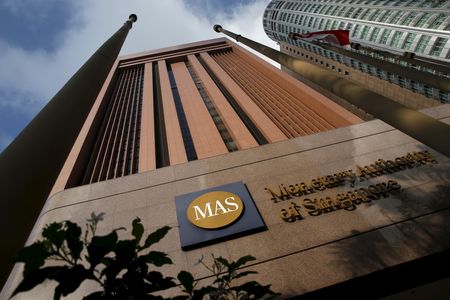
Out of 16 analysts polled by Reuters, 15 expect the Monetary Authority of Singapore (MAS) to hold off making any changes this week. MAS left settings unchanged in July and October last year after easing in January and April.
Singapore’s GDP rose 4.8% in 2025, above a government forecast in November of around 4.0% and its previous estimate of 1.5% to 2.5%.
Singapore’s strong electronics purchasing managers’ index reading of 50.9 in December showed that the tech cycle had retained momentum, Economist Intelligence Unit Asia analyst Tay Qi Hang said.
AI-related demand and rising memory chip prices should continue to benefit the semiconductor sector in coming months, he said.
“The Q4 2025 growth outperformance coupled with stable core inflation at just above 1% in November has reduced near-term pressure to ease”, he said.
Standard Chartered chief economist Edward Lee said there was no urgency to act this month with inflation under control.
However, Lee said he expected MAS to tighten policy at its April review as the inflation cycle bottoms out and trade uncertainties ease.
However, Bank of American economists said in a report on Friday that MAS could tighten policy as soon as Thursday’s review on signs that inflation is strengthening following December’s data, also released on Friday.
They said MAS could raise its core inflation forecast range for 2026 by 50 basis points to 1% to 2%, from its current forecast range of 0.5% to 1.5%.
The economists noted the data showed price increases of travel-related and other components more than offset a fall in raw food and beverage prices.
MAS will update its inflation forecasts in Thursday’s monetary policy statement.
Singapore manages monetary conditions by letting the local dollar rise or fall against the currencies of its main trading partners within an undisclosed trading band, known as the Singapore dollar nominal effective exchange rate (S$NEER).
It adjusts settings via three levers: the slope, mid-point and width of the band.
Major central banks are expected to hold rates steady in the near term, although uncertainties about the U.S. Federal Reserve’s independence remain a financial market concern.
The sharply-divided Federal Reserve cut interest rates by 25 basis points at its December meeting but signalled that easing will be paused as it awaited clarity on the state of the job market, inflation and the economy.
U.S. President Donald Trump has repeatedly criticised Fed chair Jerome Powell for not lowering rates more aggressively.
The European Central Bank’s chief economist Philip Lane said in January that it will not debate any rate change in the near term if the economy stays on course.
(Reporting by Jun Yuan Yong: Editing by Neil Fullick)
Brought to you by www.srnnews.com