

LONDON (AP) — Can it be that, like many baby boomers, King Charles III feels misunderstood?
That might sound like a strange question for a man with his own public relations team and easy access to any journalist in the realm. But 16 years after he wrote a book explaining his vision for saving the planet, the king has teamed up with Amazon Prime to make a film spelling out that philosophy.
The documentary delves into Charles’ concept of “harmony,” the idea that restoring the balance between the human and natural worlds is crucial to combatting global warming and many other major problems facing humanity.
Along the way, the king also confronts his critics, who have lampooned him as a dilettante flitting aimlessly from one cause to another with no rhyme or reason. Charles believes that climate change, urban planning, sustainable agriculture, traditional crafts and fostering understanding between religions — causes to which he has devoted much of his adult life — are inter-related issues that must be dealt with to create more liveable communities.
“I think we need to follow harmony if we are going to ensure that this planet can support so many,’’ he said in a trailer for the film. “It’s unlikely there’s anywhere else.’’
To help explain these ideas, experts including Tony Juniper, the former head of Friends of the Earth in England, Wales and Northern Ireland, and Emily Shuckburgh, a University of Cambridge climate scientist, appear with Charles in “Finding Harmony: A King’s Vision,” available on Amazon from Feb. 6. The narrator is Kate Winslet.
The king wants people to recognize that humans are as much a part of the natural world as the birds and the trees, something that can be obscured as we rush to work in air-conditioned offices, then drive to the supermarket to buy food wrapped in plastic, Juniper told The Associated Press.
The “cycles and loops” of nature are still what govern human society, Juniper said, and reconnecting with that is critical as we confront global warming, soil erosion, ocean plastics and the chemicals building up in our food chains.
“All of that is reversible, all of that fixable,” he said. “But it’s going to require more of us to understand that we are not outside nature, we are in it.”
Juniper believes Charles is uniquely qualified to deliver this message because he has been campaigning on these issues for decades and continues to do so even as other world leaders shun environmental protection.
“If there’s one person in the world who is literally a globally recognized figure, who has authenticity derived from an incredible track record on these subjects, it is King Charles III,” Juniper said.
Charles addressed the idea of restoring balance in the natural world in his 2010 book “Harmony: A New Way of Looking at Our World,” written with Juniper and Ian Skelly, a former BBC presenter.
So why return to the subject now?
Part of it may be the hope of reaching a new audience through a streaming service with global reach. Prince William, Charles’ heir, ventured into the same space last year when he revealed his plans for the monarchy on comedian Eugene Levy’s Apple TV show “The Reluctant Traveler.”
But the king also wants to shift the focus back to an issue he hopes will define his legacy after two years in which the media, and the public, were distracted by other matters, said Ed Owens, author of “After Elizabeth: Can the Monarchy Save Itself?”
First there was Charles’ cancer diagnosis, which forced him to step away from public duties for several months in early 2024 and raised nagging questions about his health. Then there were the continuing tensions with his younger son, Prince Harry, and the scandal surrounding his brother Andrew’s links to the convicted sex offender Jeffrey Epstein.
With Charles apparently past the worst of his cancer treatmen t, and Andrew stripped of his titles, now may be the time to turn the page.
“Let us not be in any in any doubt, that this is a very deliberate attempt to rebrand monarchy after a couple of very difficult years,” Owens said.
Even so, the king can’t be accused of only taking up these issues recently.
Charles gave his first speech on the environment in February 1970, when he was just 21 and still a student at Cambridge.
In 1990, he founded Dumfries House, the flagship project of the King’s Foundation, to promote sustainable agriculture, traditional arts and crafts, health and well-being.
The house and surrounding 2,000-acre estate in southwestern Scotland operate as a laboratory of sorts for the philosophy of harmony, offering courses that seek to teach the principles of nature while preparing students to work on farms, in hotels and restaurants — and on construction sites.
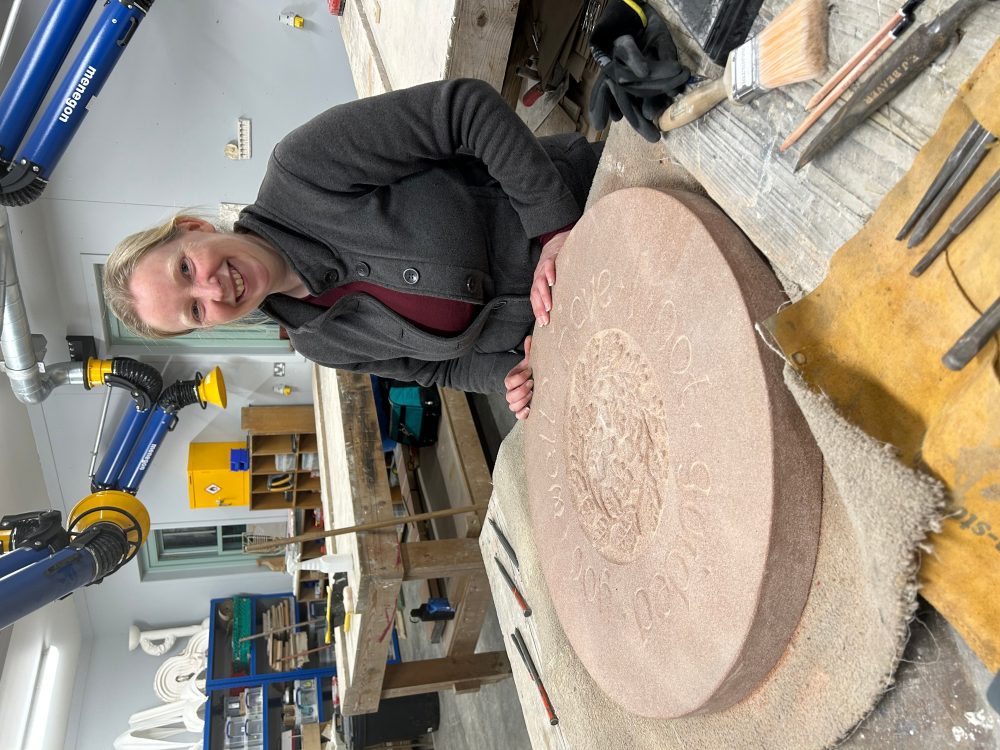
Among those who is attending a course at Dumfries House is Jennie Regan, 45, who is training to be a stonemason after 15 years as a university administrator.
On a recent afternoon, Regan stood proudly behind a carving she created bearing the inscription “Have I not guided you well?” — a nod to the story of the benevolent Scottish fairy Ghillie Dhu who led a lost child to safety.
The carving, which will adorn the floor of a wildlife hide, a hidden woodland shelter for observing nature, is an example of what attracted her to stonemasonry: the ability to combine her love of nature with the goal of making something that will last for years.
“Things need to be sustainable,″ Regan said. “Building sites have so much waste.’′
Shuckburgh, who collaborated with the king on a children’s book about climate change, said the documentary offers a hopeful vision for addressing the challenges facing the world.
“It feels as though we’re living through difficult times,’’ said Shuckburgh, director of Cambridge Zero, the university’s effort to address the climate crisis. “Having something that provides that sense of hope and optimism is really, really important.”
Brought to you by www.srnnews.com