


CAIRO (AP) — Desperate Palestinians at a garbage dump in a Gaza neighborhood dug with their bare hands for plastic items to burn to keep warm in the cold and damp winter in the enclave, battered by two years of the Israel-Hamas war.
The scene in the Muwasi area of the city of Khan Younis contrasted starkly with the vision of the territory projected by world leaders gathered in Davos, Switzerland, where they inaugurated U.S. President Donald Trump’s Board of Peace that will oversee Gaza.
At the World Economic Forum in Davos, Trump claimed that “record levels” of humanitarian aid had entered Gaza since the October start of a U.S.-brokered ceasefire deal. His son-in law, Jared Kushner, and envoy Steve Witkoff triumphantly touted the devastated territory’s development potential.
In Gaza, months into the truce, hundreds of thousands of Palestinians still languish in displacement camps, sheltering in tents and war-ravaged buildings, unable to protect them from the temperatures dropping below 10 degrees Celsius (50 Fahrenheit) at night.
Despite the ceasefire, there are still recurring deadly strikes in Gaza. Israeli tank shelling on Thursday killed four Palestinians east of Gaza City, according to Mohamed Abu Selmiya, director of the Shifa Hospital, where the bodies were taken. The Israeli military did not immediately comment.
While aid flow into Gaza has significantly increased since the ceasefire, residents say fuel and firewood are in short supply. Prices are exorbitant and searching for firewood is dangerous. Two 13-year-old boys were shot and killed by Israeli forces on Wednesday as they tried to collect firewood, hospital officials said.
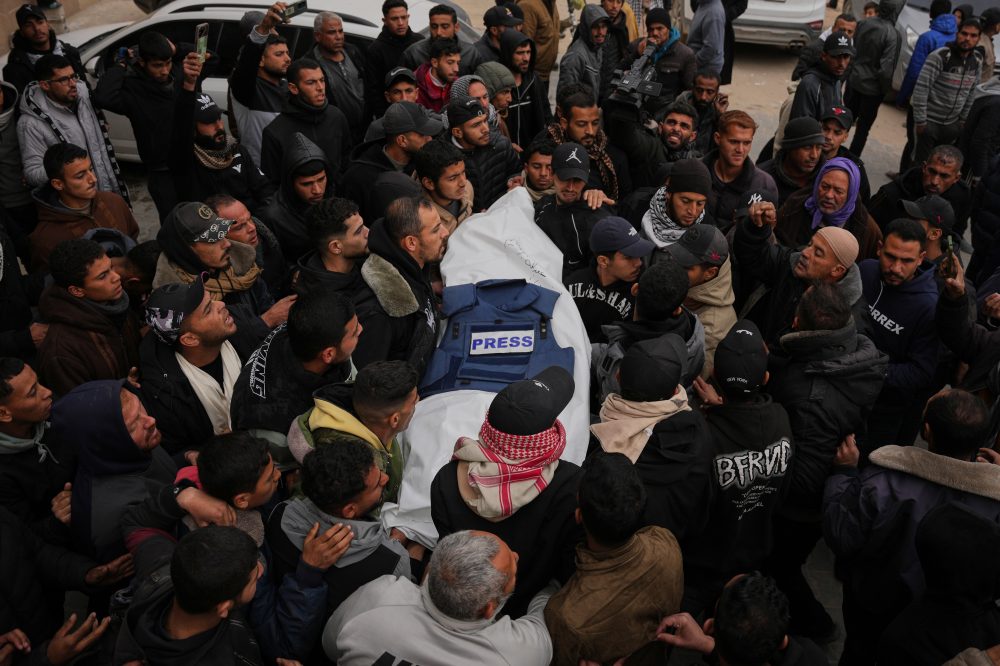
At the Nasser hospital in southern Gaza, dozens of Palestinians gathered Thursday to mourn three Palestinian journalists — including a frequent contributor to Agence France-Presse — killed the day before when an Israeli strike hit their vehicle, according to Gaza health officials.
The Israeli military said the strike came after it spotted suspects who were operating a drone that posed a threat to its troops.
For Sanaa Salah, who lives in a tent with her husband and six kids, starting a fire is a critical daily chore so they can cook and keep warm. Her family has barely has enough clothes to keep them warm.
She said the family cannot afford to buy firewood or gas, and that they are aware of the dangers of burning plastic but have no other choice.
“Life is very hard,” she said as her family members threw plastic and paper into a fire to keep it burning. “We cannot even have a cup of tea.”
“This is our life,” she said. “We do not sleep at night from the cold.”
Firewood is just too expensive, said Aziz Akel. His family has no income and they can’t pay the 7 or 8 shekels (about $2.5) it would cost.
“My house is gone and my kids were wounded,” he said.
His daughter, Lina Akel, said he leaves the family’s tent early each morning to look for plastic in the garbage to burn — “the basics of life.”
The three journalists killed Wednesday were filming near a displacement camp in central Gaza, managed by an Egyptian government committee, said Mohammed Mansour, the committee’s spokesperson.
One of them, Abdul Raouf Shaat, a regular contributor to AFP, was not on assignment for the news agency at the time of the strike, it said. A statement from AFP later demanded a full investigation into his death.
According to the Committee to Protect Journalists, more than 200 Palestinian journalists and media workers have been killed in Gaza since the war began in 2023, including visual journalist Mariam Dagga, who worked for The Associated Press and other news organizations.
Nearly five months after the strikes on a hospital that killed Dagga and four other journalists, the Israeli military says it is continuing to investigate.
Aside from rare guided tours, Israel has barred international journalists from entering to cover the war. News organizations rely largely on Palestinian journalists in Gaza — as well as residents — to show what is happening.
More than 470 people have been killed in Gaza since the ceasefire began in October, according to Gaza’s health ministry. At least 77 have been killed by Israeli gunfire near a ceasefire line that splits the territory between Israeli-held areas and most of Gaza’s Palestinian population, the ministry says.
The ministry, which is part of the Hamas-led government, maintains detailed casualty records that are seen as generally reliable by U.N. agencies and independent experts.
Mourners on Thursday wept over the bodies of the dead journalists, whose bodies were covered in body bags and had press vests placed on their chests. Funeral prayers were held later.
___
Frankel reported from Jerusalem.
Brought to you by www.srnnews.com