

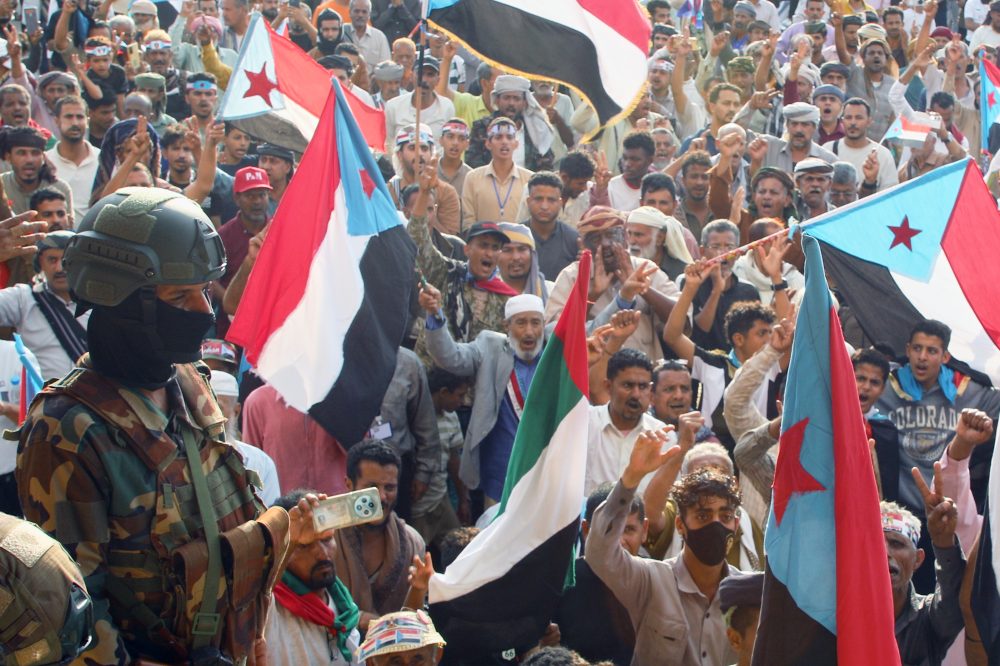
ADEN, Yemen (AP) — A large crowd of protesters rallied in southern Yemen on Friday to call for the secession of the south and to show support for an Emirati-backed southern separatist group more than a week after it dismantled itself.
Supporters of the Southern Transitional Council, or STC, rallied in Khor Maksar district, where Aden’s international airport is located. Last weekend, protesters held a rally at the same location in Aden, Yemen’s interim capital where the internationally recognized government is based.
The STC’s satellite news channel, AIC, aired footage showing what appeared to be thousands of demonstrators chanting slogans against Saudi Arabia and in support of STC leader Aidarous al-Zubaidi and the Council’s declaration of an independent south.
The people carried flags of South Yemen, which existed as an independent state from 1967 to 1990, and some carried posters of al-Zubaidi, who, according to STC media footage, fled Aden to the United Arab Emirates earlier this month.
The separatist demands in southern Yemen are one element in a complex civil war that has gripped the county since 2014, when Houthi rebels backed by Iran descended from their northern stronghold and seized the capital, Sanaa, forcing the internationally recognized government to flee first southward, then into exile in Saudi Arabia.
The war involves a complex interplay of sectarian and tribal grievances and the involvement of regional powers.
The STC was established in 2017 as an umbrella organization for groups that seek to restore southern Yemen as an independent state. Its support has been fed by grievances caused by a sense that people in the south did not benefit in a unified Yemen.
It has received financial and military support from the UAE. In 2022 it became part of an anti-Houthi alliance led by the Saudis.
But last month, the STC made advances in Hadramout and al-Mahra governorates, pushing out the Saudi-aligned National Shield Forces, and forcing simmering tensions between Riyadh and Abu Dhabi into the open.
Ahmed al-Sheaiby, an STC supporter, told The Associated Press that he joined the protest to show support for al-Zubaidi and to reclaim southern Yemen.
“Our state is coming, no matter the challenges, and we will continue the protests until the southern state is restored,” said another demonstrator Marwan al-Dahli.
Protester Ahmed Salem said that establishing an independent state in the south would benefit residents there.
“It will lead to improved living conditions and having control over the south’s oil and gas wealth which is being robbed by the northerners,” he explained.
Shortly after STC advanced in the southern governorates in December, the Saudi-backed forces later regained control of Hadramout, the presidential palace in Aden and camps in al-Mahra following days of airstrikes, while the STC announced it would dissolve itself, although some members disputed that decision.
The Saudi-backed Presidential Leadership Council on Thursday replaced prime minister Salem bin Breik of the internationally recognized government following his resignation, appointing Foreign Minister Shae’a al-Zandani to form a new cabinet.
PLC vice president Abdualla al-Alimi said on X that the move comes at a “pivotal stage that requires doubled efforts to normalize the situation and strengthen the institutional structure of the state.”
The military operations by the STC on Saudi Arabia’s borders in December were viewed as a threat to the kingdom’s national security, and Saudi officials welcomed the council’s earlier announcement that it would dissolve.
Riyadh is expected to host a conference to discuss the situation in the south with influential southern figures. A date for the conference has not been announced yet.
U.N. aid coordinator Ramesh Rajasingham told the Security Council on Wednesday that Yemen’s humanitarian crisis is deteriorating and that millions of Yemenis are not receiving the assistance they need to survive.
“More than 18 million Yemenis — or half the population — will face acute food insecurity next month,” he said. “They will be hungry — tens of thousands catastrophically so, facing famine-like conditions.”
In a video briefing from Geneva on Wednesday, he cited a lack of funding and difficulties operating especially in Houthi-controlled areas. He said girls and women are hardest hit and nearly half of Yemen’s children under 5-years-old are acutely malnourished
U.N. special envoy Hans Grundberg warned the council that Yemen’s political, economic and security challenges “are inseparable, and progress in one will not hold without progress in the others.”
___
Khaled reported from Cairo. Associated Press writer Edith M. Lederer contributed to this report from the United Nations.
Brought to you by www.srnnews.com