

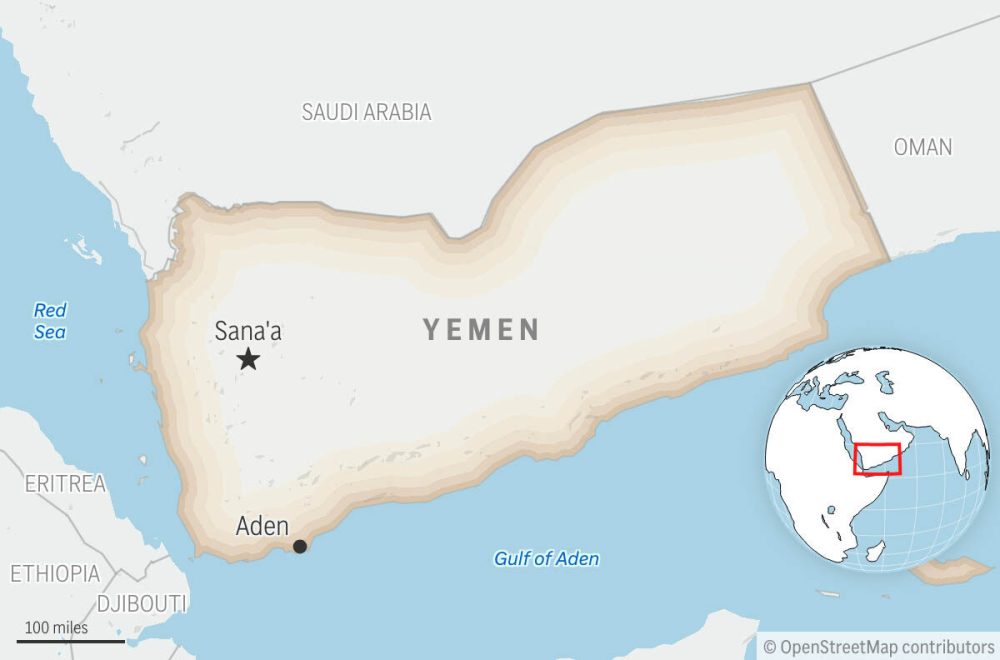
ADEN, Yemen (AP) — Thousands of Yemenis gathered Saturday in the southern city of Aden in a show of support for a separatist group backed by the United Arab Emirates, a day after the group dissolved itself, following heightened tensions and armed clashes with forces of Yemen’s internationally recognized government.
Supporters of the Southern Transitional Council assembled in their stronghold of Khor Maksar district, where Aden’s international airport is located. Armed groups loyal to the STC were seen securing the protest area, according to an Associated Press journalist in Khor Maksar.
The protesters chanted slogans against Saudi Arabia and the Yemeni international government. They waved flags of southern Yemen, which was an independent state between 1967 and 1990. Some were seen holding posters showing the council’s leader Aidarous al-Zubaidi who fled Aden to the UAE earlier this month, video footage aired by STC media showed.
Yemen, located at the strategic southern entrance of the Red Sea, has been mired for more than a decade in a civil war that involves a complex interplay of sectarian and tribal grievances and the involvement of regional powers.
Saturday’s protest came amid heightened tensions between U.S. allies Saudi Arabia and the UAE as their yearslong partnership in the war in Yemen breaks down.
Established in April 2017, the council was an umbrella organization for groups that seek to restore southern Yemen as an independent state, as it was between 1967 and 1990. It received financial and military support from the UAE.
Al-Zubaidi, who was also a member of the ruling Presidential Transitional Council, was smuggled to Abu Dhabi through Somalia after he reportedly declined to attend deescalation talks in Riyadh, according to Saudi Arabia. An STC delegation attended the talks last week and then announced the dissolution of the separatist body.
Abdulrahman Jalal al-Sebaihi, secretary-general of the secessionist council, announced on Friday that the STC would shut down all of its bodies and offices inside and outside Yemen, citing internal disagreements and mounting regional pressure.
However, Anwar al-Tamimi, a spokesman for the council, contested the decision, and wrote on X that only the full council, under its president, can take such steps — highlighting the internal divisions within the separatist movement.
Tensions between Riyadh and Abu Dhabi exploded early last month when UAE-backed forces took over the provinces of Hadramout, on the borders with Saudi Arabia, and Mahra, where they seized oil-rich areas and facilities. They also seized the presidential palace in Aden.
After weeks of Saudi-led efforts to deescalate, government forces, backed by the Kingdom, launched an attack on the STC, forcing the separatists out of Hadramout, the presidential palace in Aden and military camps in Mahra.
The escalation in southern Yemen was the latest twist in the civil war that has gripped the county since 2014, when Houthi rebels backed by Iran descended from their northern stronghold and seized the capital, Sanaa, forcing the internationally recognized government to flee first southward, then into exile in Saudi Arabia.
A Saudi-led coalition that included the United Arab Emirates entered the Yemen war the following year in an attempt to restore the government. The war has remained at a stalemate in recent years, and the rebels reached a deal with Saudi Arabia that stopped their attacks on the kingdom in return for an end to Saudi-led strikes on their territories.
________
Magdy reported from Cairo.
Brought to you by www.srnnews.com