


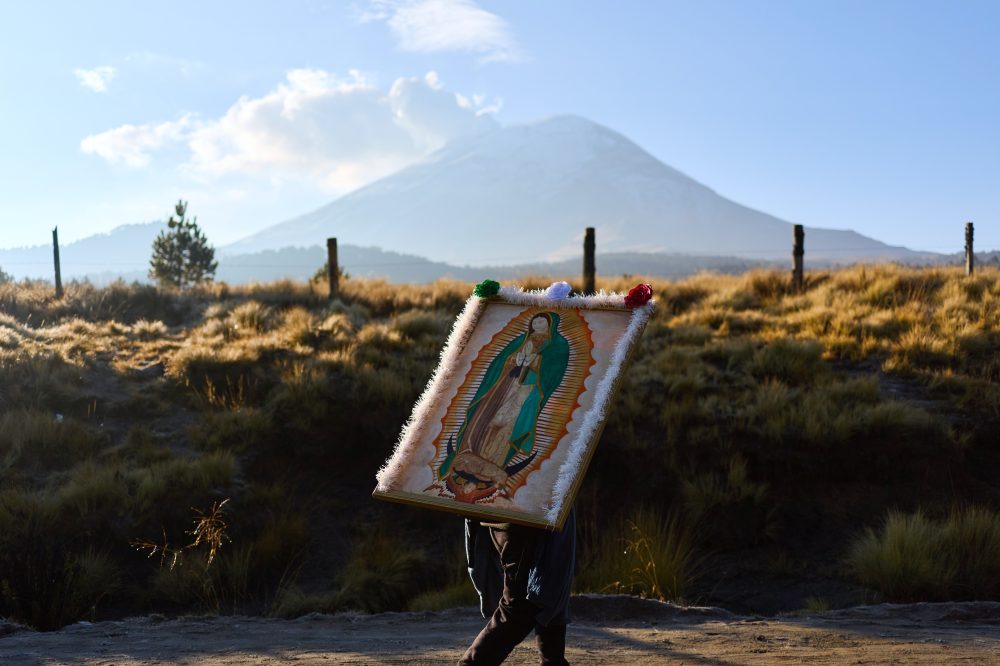
MEXICO CITY (AP) — There’s a saying in Mexico: “Not all Mexicans are Catholic, but all are Guadalupan.”
The phrase conveys the deep connection between Our Lady of Guadalupe and the country’s identity. In the nation of 130 million people — the majority of whom identify as Catholic — this apparition of the Virgin Mary carries a symbolic force that often surpasses religious belief.
“After Mexico emerged as an independent nation, she came to embody not just religious devotion but a sense of national identity,” said Nydia Rodríguez, director of a museum dedicated to the Virgin at Mexico City’s Basilica. The sanctuary draws up to 12 million pilgrims during her feast day each Dec. 12.
Mexico’s official emblem is an eagle perched on a cactus while devouring a serpent. The Virgin’s likeness is often on display alongside it in government buildings, banners and portraits of political leaders.
“Mexico is a secular state, but in its history there has always been religion,” Rodríguez said. “Our pre-Hispanic ancestors and Spanish society were deeply religious and there’s a point where both traditions meet.”
Among the pieces on display at the museum is a 19th-century painting known as the “Virgin of Congress.” It stands at the center of the main hall, flanked by two golden eagles and framed by Mexican flags.
“This was a gift for the first Constitutional Congress,” Rodríguez said. “In a way, it legitimized those political leaders as if Our Lady of Guadalupe was backing up that Congress.”
The museum’s “Virgin of Congress” is no ordinary painting. It belongs to a group of artworks classified as “touched by the original,” a term used by Mexican scholars to describe a devotional copy of the original image.
According to the Catholic Church, that very first icon is considered a miracle. Its backstory describes the Virgin’s apparition on a cold December night in 1531.
Under that belief, an Indigenous man named Juan Diego saw Our Lady of Guadalupe near Tepeyac Hill, where the current Basilica stands. She is said to have asked for a temple to be built to honor her son, Jesus Christ, but the local bishop was skeptical.
Guided by her instruction, Juan Diego placed flowers in his cloak. And when he later opened it, a colorful image of the Virgin appeared.
That cloth hangs in the center of the Basilica. Pilgrims travel from across Mexico all year long to give thanks for the miracles they believe the Virgin has granted them.
Teresa Morales is among them. The 85-year-old made a recent visit to the shrine ahead of Dec. 12 to show gratitude for her good health.
She said she felt tormented by knee pain that barely allowed her to walk. But as she prayed to an image of Our Lady of Guadalupe that she keeps at home, her suffering stopped.
“The other day I came for confession and the priest told me to spread the word,” she said. “To tell everyone that her miracles are real.”
Our Lady of Guadalupe’s power to bring people together was key when Mexico’s movement for independence began in 1810.
The fight against Spanish rule was led by a priest called Miguel Hidalgo y Costilla. Now considered the father of the nation, he rose up in arms one early morning in September carrying an image of the Virgin.
It was originally a painting that hung in a sanctuary in central Mexico. Aware of its symbolic force, Hidalgo tied it to a lance and used it as his banner.
“The priest was leading the people against the bad government,” said Salvador Rueda, historian and director of Mexico’s National Museum of History, where the iconic canvas is on display. “And why did everybody follow? Because Our Lady of Guadalupe represents us all.”
Multiple galleries within the museum convey how the Virgin has played a double function in recent centuries. Her presence in private lockets, a mural by modernist architect Juan O’Gorman and medals granted by Mexico’s first emperor to praise patriotic services show how it has been both a devotional image and a civic symbol.
According to Rueda, some visitors cross themselves when they spot the first painting at the exhibition. However, their reaction shifts as they approach Hidalgo’s banner. “One is followed by devotion,” he said. “The other is a flag.”
Further armies embraced the Virgin’s image in their causes. While details differ, both the Cristeros and the Zapatistas depicted her in their flags during the early 20th century.
“What started as a devotion ended up becoming a public image,” Rueda said. “A reference to one’s identity not as Catholic, but as Mexican.”
While several experts have wondered whether the cloth at the Basilica is a painting rather than a miraculous object, Rueda said that historians should not care.
“Why would that matter?” he asked. “It’s real because it’s part of reality, of history. Because it shapes an entire world.”
___
Associated Press religion coverage receives support through the AP’s collaboration with The Conversation US, with funding from Lilly Endowment Inc. The AP is solely responsible for this content.
Brought to you by www.srnnews.com